In vitro, antioxidant activities of aqueous and methanol roselle (Hibiscus sabdariffa) calyces extracts from two localities in Cameroon
Copyright © 2020 Authors

This work is licensed under a Creative Commons Attribution 4.0 International License.
- Attribution — You must give appropriate credit, provide a link to the license, and indicate if changes were made.
- No additional restrictions — You may not apply legal terms or technological measures that legally restrict others from doing anything the license permits.





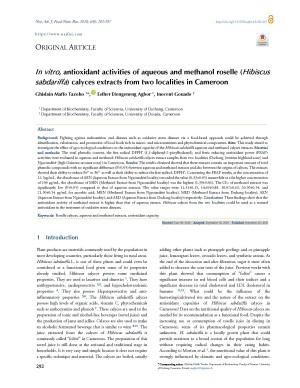
Background: Fighting against malnutrition and diseases such as oxidative stress diseases via a food-based approach could be achieved through identification, valorization, and promotion of local foods rich in macro- and micronutrients and phytochemical components. Aim: This study aimed to investigate the effect of agro-ecological conditions on the antioxidant capacity of the Hibiscus sabdariffa aqueous and methanol calyces extracts. Material and methods: The total phenolic content, the free radical DPPH• (1,1-diphenyl-2-picrylhydrazyl), and ferric reducing antioxidant power (FRAP) activities were evaluated in aqueous and methanol Hibiscus sabdariffa calyces extract samples from two localities (Dschang [western highland zone] and Ngaoundéré [high Guinean savanna zone]) in Cameroon. Results: The results obtained showed that these extracts contain an important amount of total phenolic compounds with no significant difference (P>0.05) between aqueous and methanol extracts and also between the origins of calyces. The extracts showed their ability to reduce Fe3+ to Fe2+ as well as their ability to reduce the free radical, DPPH•. Concerning the FRAP results, at the concentration of 12.5µg/mL, the absorbance of AEN (Aqueous Extract from Ngaoundéré locality) recorded the value (0.33±0.05) meanwhile at a far higher concentration of 200 µg/mL, the absorbance of MEN (Methanol Extract from Ngaoundéré locality) was the highest (1.39±0.06). The CI50 of methanol extracts was significantly low (P<0.05) compared to that of aqueous extracts. The value ranges were 11.31±0.15, 14.69±0.84, 18.07±0.63, 20.50±0.54, and 21.50±0.54 µg/mL for ascorbic acid, MEN (Methanol Extract from Ngaoundéré locality), MED (Methanol Extract from Dschang locality), AEN (Aqueous Extract from Ngaoundéré locality), and AED (Aqueous Extract from Dschang locality) respectively. Conclusion: These findings show that the antioxidant activity of methanol extract is higher than that of aqueous extract. Hibiscus calyces from the two localities could be used as a natural antioxidant in the treatment of oxidative stress diseases.
Keywords
How to Cite
Similar Articles
- Phytochemical analysis, antioxidant and anti-Candida albicans activities of Annona cherimola Mill. fruit pulp
- Comparison of five solvents in the extraction of phenolic antioxidants from pomegranate (Punica granatum L.) peel
- Comparative study of total phenolic content and antioxidant proprieties of Quercus fruit: flour and oil
- Exploring the Antioxidant Potential and HPLC Profile of Fenugreek (Trigonella foenum-graecum L.) Seed Extracts
- Antioxidant activity and polyphenol composition of Pistacia terebinthus fruit from Tessala (Western Algeria)
- Determination of sensory, microbiological and antioxidant properties of tortilla added with roselle decoction calyxes powder
- Phenol content, potential antioxidant and anti-urolithic effects of fruit and leaf extracts from Algerian Capparis spinosa L.
- Assessment of antioxidant and antibacterial activity of Phoenix dactylifera L. seed extracts: Perspective for the development of new foods
- Physicochemical characterization and antioxidant capacity of the extracted oil from date pits and its effect on storage stability of margarine
- Anticarcinogenic and antioxidant activities of leaves and flowers hydroalcoholic extracts of Nerium oleander L.: PCA analysis and phytochemical content by FTIR spectroscopy
You may also start an advanced similarity search for this article.

 NAJFNR is licensed under