
Share your research with the world. Submit your manuscript for peer review.
Make a SubmissionReviewers Guidelines

Guidelines for Reviewers
Peer review is an crucial part of the publication process and it ensures that the NAJFNR maintains the highest quality standards for its published papers. All manuscripts submitted to our journal are strictly and thoroughly peer-reviewed by experts.
Reviewers play a pivotal role in scholarly publishing. The NAJFNR peer review process aims to validate academic work, helps to improve the quality of published research, and increases networking possibilities within research communities.
The role of the reviewer is vital and bears a great responsibility in ensuring the integrity of the scholarly record. Every reviewer is expected to perform manuscript assessment in a timely, transparent, and ethical manner, following the COPE Ethical Guidelines for Peer Reviewers.
Reviewer Eligibility
Reviewers are selected and assigned based on suggestions from the article authors, with the editorial team ensuring that they meet our reviewer criteria. We recognise that early career researchers may not fit some of our criteria but may still possess the expertise to review. In such cases we encourage co-reviewing alongside a more senior colleague.
Please respond to the invitation as soon as you can (even if it is to decline) – a delay in your decision slows down the review process leading to significant waiting time for the author. If you are unable to accept the invitation, please try to provide suggestions for alternative reviewers.
Think About Their Work
The NAJFNR relies on the time and expertise of volunteer reviewers to maintain its high editorial standards. We encourage reviewers to assess the following questions in a submitted paper before accepting or declining an invitation to review:
- Does the article match your area of expertise? Only accept if you feel you can provide a high-quality review;
- Do you have a potential conflict of interest? Disclose this to the editor when you respond;
- Do you have enough time to perform the review task? Reviewing can be a lot of work – before you commit, make sure you can meet the deadline.
- Do you need to find out more about reviewing and the peer review process? Please read our guide.
Then to get started, ask yourself the following questions:
- What are their implications?
- What are their strengths?
- What are their weaknesses?
- How can they improve?
- What are their latest accomplishments?
- What do I like or appreciate about them?
- What do I wish they did less?
- What do I want them to do more?
- What's their contribution to the team?
Before drafting your peer review, think about your colleagues' contribution to the workplace.
Login and Review Access
Your review will be managed via our submission system. To access the paper and deliver your review, click the link in the invitation email you received which will redirect you to the submission/review system.
1. Invitation Request
Once you click the link provided in the Request for Review email you received, you will see a similar page to the one shown in the figure below. Keep in mind that you should respond (agree/decline) to the review invitation before the due date.
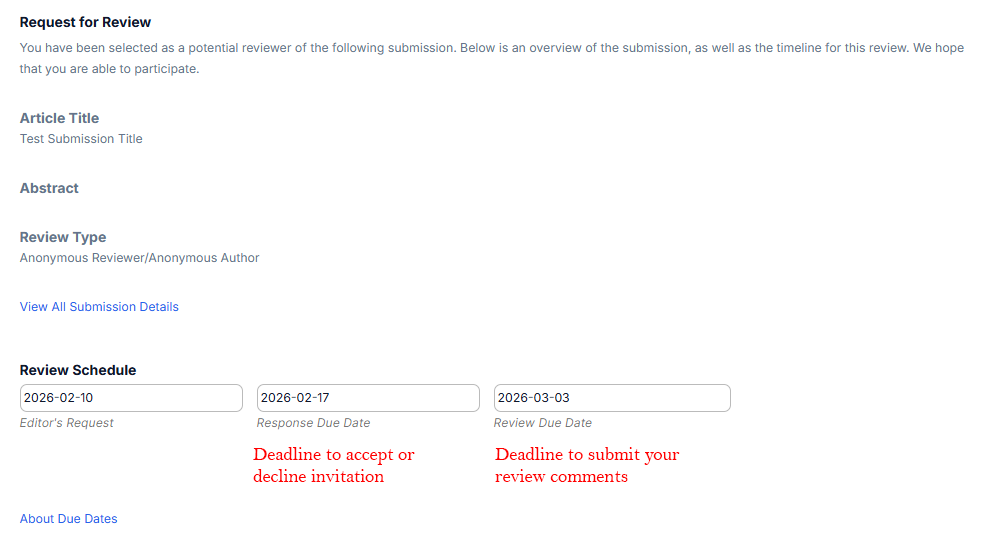
If you decided to accept the invitation, select the Yes, I agree to have my data... checkbox. Then click Accept Review to move to the next step. Otherwise, click the Decline Review button to decline and leave the system.

2. Guidelines
NAJFNR Review Form (editable version)
Please download and fill out the review form.
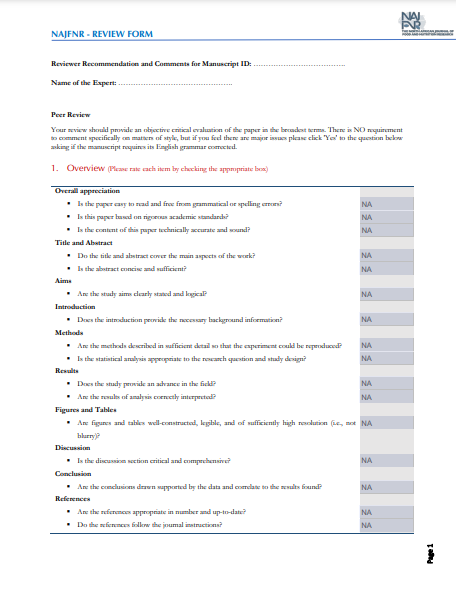
Note: As a reviewer, you can work directly on the manuscript word document and put your comments in the Review section of Microsoft Word. Please make your review anonymous, your name should not be displayed. However, filling out the NAJFNR Review Form is mandatory.
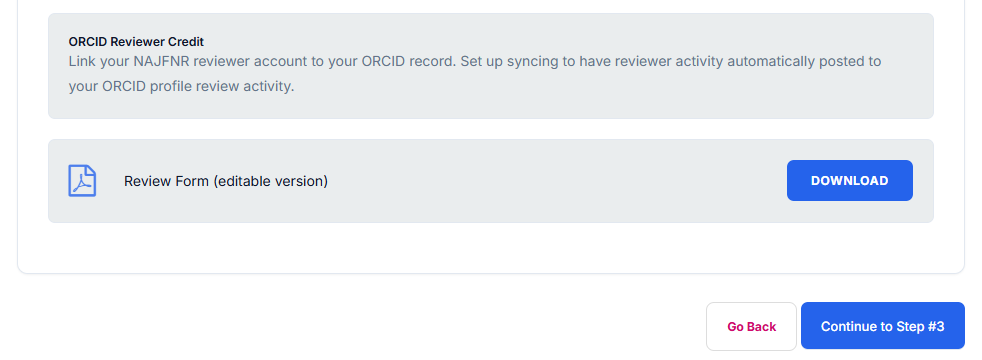
Then click on "Continue to step #3"
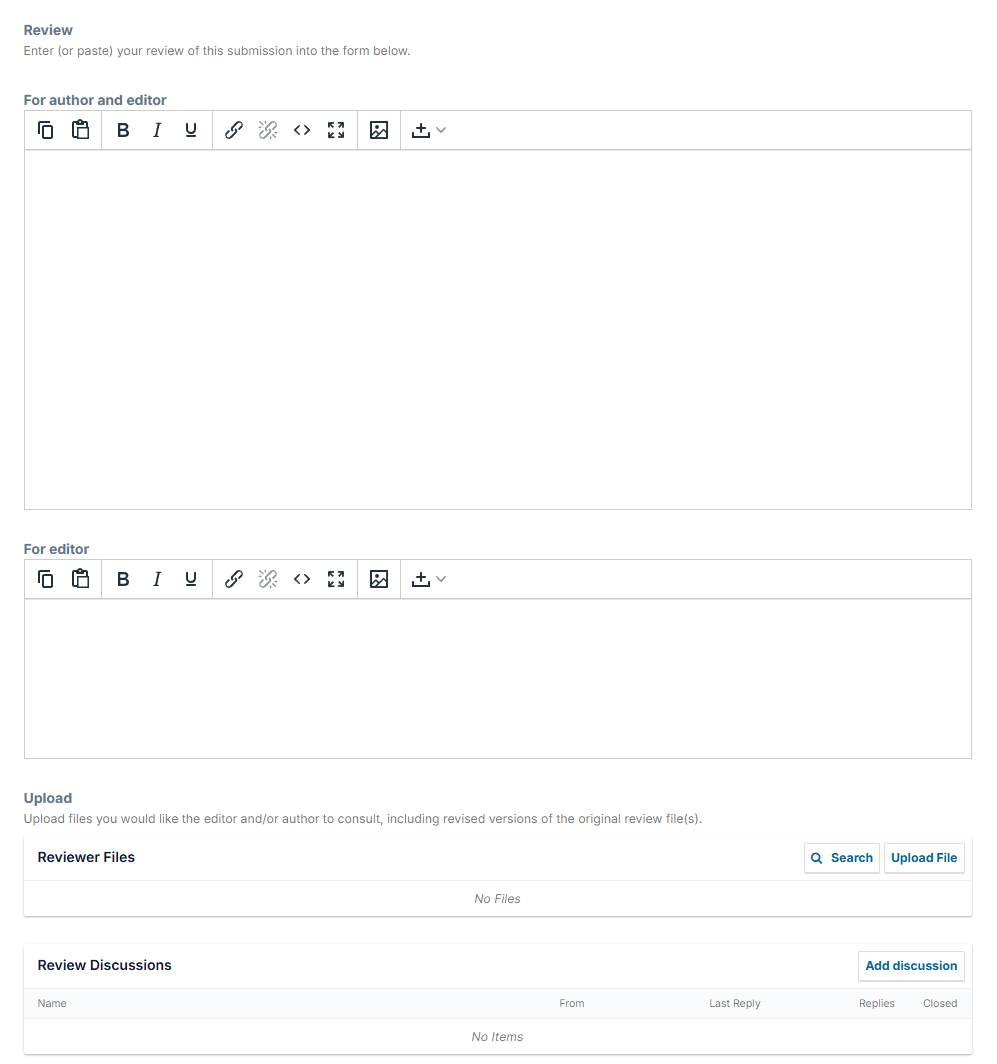
3. Download Manuscript & Upload Review
You will be redirected to the Download & Review section to download the manuscript.

After filing out the Review Form, click Upload File to upload it.
You can also upload the manuscript if you have directly made some comments on it.
4. Make Recommendation
Choose a recommendation from the available options. Finally, click Submit Review to send your review comments and the Review form.

Evaluation Criteria
A reminder that recommendations should not be made solely on novelty or perceived impact / interest.
Research published in the journal must be:
- In scope of the journal.
- Scientifically valid.
- Technically accurate in its methods and results.
- Representative of a specific advancement, replication, or null / negative result, which is worthy of publication.
- As reproducible as possible.
- Ethically sound.
A. Full-length Research Article
- Examine the importance of the research question addressed in the manuscript (e.g., are objectives and justification clearly stated?).
- Assess the originality (contribution, addition of knowledge to the scientific literature) of the manuscript.
- Clearly identify the strengths and weaknesses of the method described in the manuscript.
- Make specific useful comments on the writing of the manuscript (e.g., writing, organization, figures, etc.).
- Offer specific comments on the author’s interpretation of the results and conclusions drawn from the results.
- If applicable, comment on the statistics (for example question if they are robust and fit-for-purpose, or whether the controls and sampling mechanisms are sufficient and well described).
B. Review Article
- Discuss the importance of the topic / scope of the review.
- Assess the originality of the review.
- Comment on the author's representation of the most relevant recent advances in the field. Specifically, determine whether the references are relevant to the topic and cover both historical literature and more recent developments.
- Offer comments on the writing, organization, tables, and figures of the manuscript.
- Comment on the author's interpretation of the results.
C. Systematic Review
How to Critically Appraise a Systematic Review?
- Are the rationale for, and objectives of, the systematic review clearly stated?
- Was the search for relevant primary studies to include in the review detailed and exhaustive?
- Were the criteria used to select studies for inclusion in the review appropriate?
- Were the included primary studies of high methodological quality?
- Were the assessments of the studies reproductible?
- Are the conclusions drawn adequately supported by the results presented in the review?
Publication bias concept: Appropriate means unbiased. Authors should not only select studies that support their point of view. Authors need to let the data develop their point of view.
D. Opinion Article
- Is the topic of the opinion article discussed accurately in the context of the current literature?
- Are all factual statements correct and adequately supported by citations?
- Are arguments sufficiently supported by evidence from the published literature?
- Are the conclusions drawn balanced and justified on the basis of the presented arguments?
E. Methodology
If the manuscript you are reviewing is reporting an experiment, check the methods section first. The following cases are considered major flaws and should be flagged:
- Unsound methodology.
- Discredited method.
- Missing processes known to be influential on the area of reported research.
- A conclusion drawn in contradiction to the statistical or qualitative evidence reported in the manuscript.
Confidential Material
Material under review is a privileged communication that should not be shared or discussed with anyone outside the designated review process unless necessary and approved by the editor.
If you wish to consult a colleague or trainee for assistance with the review, please ensure they are free of any competing interest, agree to abide by NAJFNR policies, and note their name in the appropriate field in the review form. Reviewers may not retain copies of submitted manuscripts and may not use the knowledge of manuscript content for any purpose unrelated to the peer-review process.
Constructive Critique
DO NOT
Make the peer review personal. Try to avoid using "I" such as "I do not like..." or "I am not comfortable with..." when giving constructive feedback.
DO
Tie your comments to the goal of the peer review and not your personal references.
Please do not make unhelpful feedback that can also be demotivating and discouraging. Authors may feel that their contributions are not valued or recognized.
Decision process
The editors make the final decision on whether to publish each submission based on the reviewers’ comments, the NAJFNR publication criteria, and their own assessment of the manuscript.
Criticisms & Confidential Comments to Editors
The NAJFNR gives reviewers the option to provide some confidential comments to editors. Often this is where editors will want reviewers to state their recommendation but otherwise this area is best reserved for communicating malpractice such as suspected plagiarism, fraud, unattributed work, unethical procedures, duplicate publication, bias or other conflicts of interest.
Conflicting Reviews
If reviewers appear to disagree fundamentally, the editors may choose to share all the reviews with each of the reviewers and request additional comments that may help the editors to reach a decision.
Assisting Early Researchers
Review-editors for NAJFNR now have the option of assisting early researchers and graduate students to gain experience in reviewing manuscripts. For educational purposes, NAJFNR review-editors can share the manuscript in confidence with a reviewer in training and will ultimately be responsible for undertaking the review, irrespective of the reviewer in training's involvement.

These guidelines are adapted from the Council of Science Editors Recommendations for Promoting Integrity in Scientific Journal Publications.


 NAJFNR is licensed under