
Share your research with the world. Submit your manuscript for peer review.
Make a SubmissionReview Process

The NAJFNR's review process adheres to the Committee on Publication Ethics (COPE) Code of Conduct and Best Practice Guidelines.
Peer review is performed to ensure that the North African Journal of Food and Nutrition Research publishes good science which is of benefit to the entire scientific community.
Revisions and improvement provided by our reviewers and our proofreading assistants are part of the publication process and actually help raise the quality of submitted/accepted manuscripts.
NAJFNR's Peer Review
There are several kinds of peer review utilized by journals, although the basis is always the same.
Concerning our journal, the peer review process is performed in Double blind – in this case neither authors nor reviewers know each other’s identities. However, once the article is accepted, the names or review editors will be displayed on the final published version (first page).
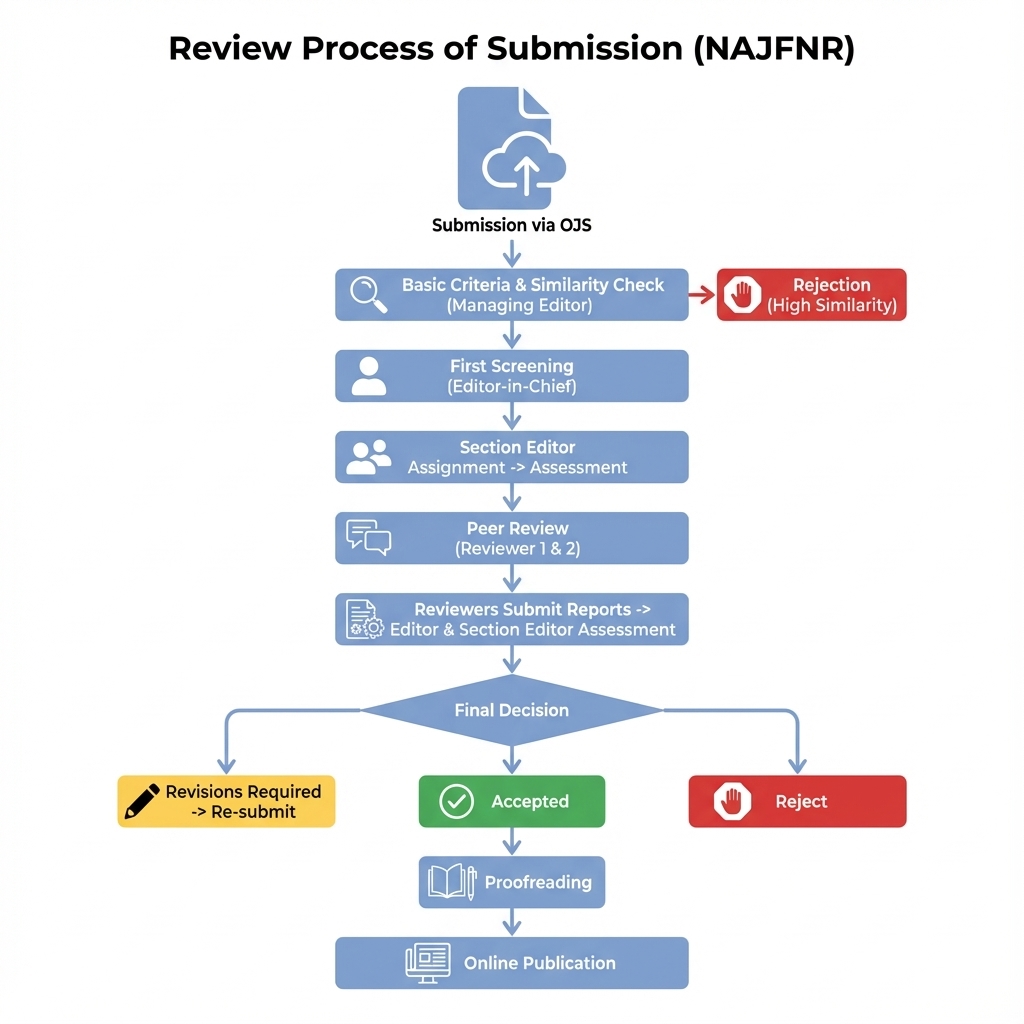
Once a manuscript is submitted to our journal, it goes through an initial screening process which involves a preliminary review by the journal editor or the editorial board. At this stage, the editor has to choose any one of the following outcomes for the paper:
1. Return without review
If the editor states that the paper does not match the scope of the NAJFNR or does not meet the basic standards or expectations the paper is returned to the corresponding author after initial screening without sending it for peer review. A paper could also be rejected at this stage if it has too many grammar and syntax errors or written in another language other than English; this is something that authors for whom English is a second language need to be careful about.
2. Send for peer review
If, after the initial screening, the editor considers that the paper matches the scope and meets the basic requirements of the journal, the manuscript will be sent for peer review. Copies of the paper are usually sent out to two to three peer reviewers. Corresponding authors is contacted and informed by email by providing a link to track submissions.
Manuscripts that are sent out for peer review receive comments and recommendations from the peer reviewers. Based on these reviews, the editor in chief takes a final decision on the manuscript. While reviewer inputs are extremely valuable for the editor, they are just recommendations, not final decisions. The final decision on the manuscript rests with the editor.
Publication Timeline
- 30 days Median Time to First Decision
- 14 weeks Average Time to Final Decision
- 20 days Average Time to Online Publication
Fast-Track Publication
Expedited publication service available for an additional USD 50 (Total APC: USD 200 excl. VAT).
Our typical fast-track timeline:
- 20 days Median Time to First Decision
- 10 weeks Average Time to Final Decision
- 15 days Average Time to Online Publication
More information: Please visit Journal Insights and Metrics.
For further guidance: Refer to the COPE Ethical Guidelines for Peer Reviewers. Available online.
Editor Decisions
An editor makes one of the following decisions for a peer–reviewed manuscript:
- Accept in its present form
The journal will publish the paper in its original form, and no changes are required. (Extremely unusual).
- Accept with minor revisions
Also known as conditional acceptance. Requires minor changes. Usually, the editor goes through the revisions and gives a final approval without a second round of review.
- Accept with major revisions
An editor arrives at this decision when a manuscript needs to be substantially improved before it can be accepted. The author has to submit the revised manuscript along with a point-by-point response to the reviewer comments. The revised manuscript is likely to be sent for a second round of peer review. Usually, the paper is sent to the same set of reviewers who had reviewed it the first time, but the editor may choose to send it to a different set of reviewers. The results of the second review (rereview), are based on how well the author has addressed the reviewer and editor comments. In case the author is unable to address all the comments in a satisfactory manner, further revisions may be required or, in the worst case, the paper might be rejected.
- Revise and resubmit
The manuscript is rejected, but the editor shows willingness to consider the manuscript if it is revised and resubmitted as a new submission. If the author wishes to proceed with this, s(he) needs to revise the paper substantially based on the reviewer and editor comments, and submit it as a new submission. This submission needs to be accompanied by a letter that states the original submission id and explains how the reviewers' comments have been addressed. The editor will review the revised paper and the letter and send the paper for a new round of peer review if required.
- Reject
Outright rejection. In most cases, the journal will not publish the paper or reconsider it even if the author makes major revisions.
Common Reasons for Rejection
Your manuscript could be rejected for many reasons (technical or editorial).
Technical Reasons
- Incomplete data such as too small a sample size or missing or poor controls.
- Poor analysis such as using inappropriate or lack statistical tests.
- Inappropriate methodology for answering your hypothesis or using old methodology.
- Weak research motive where hypothesis is ambiguous, not scientifically valid, or your data does not answer the question posed.
- Inaccurate conclusions on assumptions that are not supported by your data.
Editorial Reasons
- Out of scope for our journal.
- Not enough impact for the journal.
- Plagiarism and violation of publication ethics.
- Research ethics not considered (patients' consent, approval from an ethics committee for animal research, etc.).
- Lack of proper structure or not following formatting requirements.
- Lack of necessary detail to reproduce analysis.
- Lack of up-to-date references or too many self-citations.
- Poor language quality.
- Difficult to follow logic or poorly presented data.
Manuscript Revision
Once your manuscript has come back from reviewers, you may be given the opportunity to revise it. You will usually receive a letter outlining changes you need to make and links to the reviewer reports. This letter contains information on how to return your revised manuscript including instructions on how to highlight the changes made and when you need to return the revised version.
After revising your manuscript and responding to peer review comments, you must:
- Thank the reviewers and editors for their time and comments.
- Address all points raised by the editor and reviewers.
- Describe the major revisions in your response letter followed by point-by-point responses to the comments raised.
- Perform any additional experiments or analyses recommended (If you think they would not improve your paper, then please provide sufficient explanation in your response letter).
- Provide a polite and scientific rebuttal to any points you disagree with.
- Differentiate between reviewer comments and your responses.
- Clearly show the major revisions in the text, either with a different color text, by highlighting the changes, or with Microsoft Word’s Track Changes feature. This is in addition to describing the changes in your point by point cover letter.
- Return the revised manuscript within the given time period.
Manuscript Rejection & Appeals
Appeals are only successful when you can provide strong evidence or new data that can respond to and alleviate the concerns of the editor and reviewers. As appeals are matters of journal policy, they are given lower priority than new submissions and may take at several weeks to resolve.
Appeals must be rational arguments not emotional ones so be sure you have enough evidence before trying to change the editor’s mind. If you do decide to go ahead with an appeal letter you should:
- Clearly explain why you disagree and provide new information. This should not be a repetition of what you have included in your original submission or cover letter.
- Include a point-by-point response to reviewer comments.
- Provide evidence if you believe a reviewer has made technical errors or was biased.
NB: If you decide to submit your manuscript to another journal before receiving a decision from our editorial office—for example, if the review process is taking longer than expected and cannot be expedited—you must first notify the editor of your intention to withdraw the manuscript and obtain confirmation of its withdrawal before submitting it elsewhere.
Manuscript Acceptance
- Authors will be notified on the acceptance of the article.
- Dates of receipt, revision and approval will be indicated in each published article.
- Names of Review editors are displayed on the published article.
Editorial & Peer-Review Flowchart


 NAJFNR is licensed under