Phenolic compounds and antioxidant activity of different parts of three mandarin varieties extracts: A comparative study
Copyright © 2020 Authors

This work is licensed under a Creative Commons Attribution 4.0 International License.
- Attribution — You must give appropriate credit, provide a link to the license, and indicate if changes were made.
- No additional restrictions — You may not apply legal terms or technological measures that legally restrict others from doing anything the license permits.





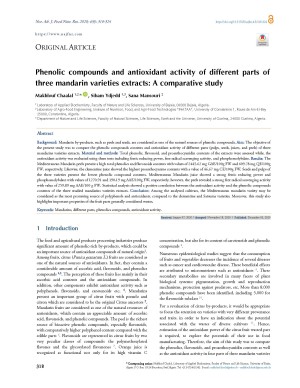
Background: Mandarin by-products, such as peels and seeds, are considered as one of the naturel source of phenolic compounds. Aim: The objective of the present study was to compare the phenolic compounds contents and antioxidant activity of different parts (pulps, seeds, juices, and peels) of three mandarins varieties extracts. Material and methods: Total phenolic, flavonoid, and proanthocyanidin contents of the extracts were assessed while, the antioxidant activity was evaluated using three tests including ferric reducing power, free radical scavenging activity, and phosphomolybdate. Results: The Mediterranean Mandarin peels present a high total phenolics and flavonoids contents with values of 2445.62 mg GAE/100g FW and 609.78 mg QE/100g FW, respectively. Likewise, the clementine juice showed the highest proanthocyanins contents with value of 46.67 mg CE/100g FW. Seeds and pulps of the three varieties present the lowest phenolic compound contents. Mediterranean Mandarin juice showed a strong ferric reducing power and phosphomolybdate with values of 1270.91 and 190.19 mg AAE/100g FW, respectively, however, the peels reveled a strong free radical scavenging activity with value of 259.89 mg AAE/100 g FW. Statistical analysis showed a positive correlation between the antioxidant activity and the phenolic compounds contents of the three studied mandarins varieties extracts. Conclusion: Among the analyzed cultivars, Mediterranean mandarin variety may be considered as the most promising source of polyphenols and antioxidants, compared to the clementine and Satsuma varieties. Moreover, this study also highlights important properties of the fruit parts generally considered wastes.
Keywords
How to Cite
Similar Articles
- Determinants of overweight and obesity among adolescents in Zimbabwe: A scoping review
- Does sex differ the relationship between macronutrients adequacy and aerobic power?
- Effect of virgin olive and Pistacia lentiscus oils fortified with tomato lycopene on biochemical parameters in Wistar rats
- Biochemical and microbiological characterization of “Soumbara” from African locust bean (Parkia biglobosa) seeds consumed in Abidjan (Côte d’Ivoire)
- Micronutrient supplementation among pregnant women in western Algeria
- Determinants of malnutrition and associated parameters in subjects with stable chronic obstructive pulmonary disease: A cross sectional study
- Rapid survey on lifestyle changes and body weight gain among Algerians during COVID-19 lockdown
- Effect of healthy lifestyle promotion on anthropometric variables, eating behavior and cardiometabolic risk factors in women with polycystic ovarian syndrome
- Assessment of phthalate knowledge, plastic use practices and cheese handling among adults in Jeddah city (Saudi Arabia)
- Update of the nutritional situation in the Republic of the Sudan
You may also start an advanced similarity search for this article.

 NAJFNR is licensed under