Bioactive compounds and antimicrobial activity of extracts from fermented African locust bean (Parkia biglobosa) against pathogenic microorganisms
Copyright © 2021 Authors

This work is licensed under a Creative Commons Attribution 4.0 International License.
- Attribution — You must give appropriate credit, provide a link to the license, and indicate if changes were made.
- No additional restrictions — You may not apply legal terms or technological measures that legally restrict others from doing anything the license permits.





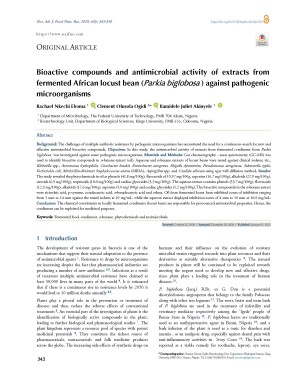
Background: The challenges of multiple antibiotic resistance by pathogenic microorganisms has necessitated the need for a continuous searching for new and effective antimicrobial bioactive compounds. Objectives: In this study, antimicrobial activity of extracts from fermented condiment from Parkia biglobosa was investigated against some pathogenic microorganisms. Materials and Methods: Gas chromatography and mass spectrometry (GC-MS) was used to identify bioactive compounds in n-hexane extract (oil). Aqueous and n-hexane extracts of locust beans were tested against clinical isolates; viz., Klebsiella spp., Aeromonas hydrophilia, Citrobacter braakii, Enterobacter aerogenes, Shigella dysenteriae, Pseudomonas aeruginosa, Salmonella typhi, Escherichia coli, Methicillin Resistant Staphylococcus aureus (MRSA), Aspergillus spp. and Candida albicans using agar well diffusion method. Results: The study revealed the phytochemicals in oil as phenols (41.8 mg/100g), flavonoids of 19.37 mg/100g, saponins (16.7 mg/100g), alkaloids (22.9 mg/100g), steroids (6.9 mg/100g), terpenoids (10.0 mg/100g) and cardiac glycosides (3.3 mg/100g). The aqueous extract contains phenols (33.7 mg/100g), flavonoids (12.3 mg/100g), alkaloids (17.6 mg/100g), saponins (5.0 mg/100g) and cardiac glycosides (1.2 mg/100g). The bioactive compounds in the n-hexane extract were ricinoleic acid, p-cymene, octadecanoic acid, n-hexadecanoic acid and others. Oil from fermented locust bean exhibited zones of inhibition ranging from 5 mm to 14 mm against the tested isolates at 10 mg/mL, while the aqueous extract displayed inhibition zones of 4 mm to 10 mm at 10.0 mg/mL. Conclusion: The chemical constituents in locally fermented condiment (locust bean) are responsible for pronounced antimicrobial properties. Hence, the condiment can be exploited for medicinal purposes.
Keywords
How to Cite
Similar Articles
- Talbina as a functional food and a source of health-beneficial ingredients: a narrative review
- Screening of Five Lactobacillus Bacteria with Probiotic Properties from Indigenous Klila Cheese
- Examination of traditional fermented food consumption and product awareness of university students in Istanbul, Turkey
- Beneficial effects of a fermented maize product with its supernatant, Lactobacillus fermentum and Lactobacillus brevis in rat model of colitis
- Effects of fermentation period and soybean flour supplementation on the glycemic indices and starch digestibility of biofortified provitamin A cassava meal
- Critical evaluation of the discrepancy between whole and refined foods: nutritional implications
- Effect of traditional sun-drying and oven-drying on carotenoids and phenolic compounds of apricot (Prunus armeniaca L.)
- Nutritional properties and plausible benefits of Pearl millet (Pennisetum glaucum) on bone metabolism and osteoimmunology : a mini-review
- Quantitative and qualitative assessment of food waste in rural markets in Morocco
- Research on food losses and waste in North Africa
You may also start an advanced similarity search for this article.

 NAJFNR is licensed under