Bioactive compounds and antimicrobial activity of extracts from fermented African locust bean (Parkia biglobosa) against pathogenic microorganisms
Copyright © 2021 Authors

This work is licensed under a Creative Commons Attribution 4.0 International License.
- Attribution — You must give appropriate credit, provide a link to the license, and indicate if changes were made.
- No additional restrictions — You may not apply legal terms or technological measures that legally restrict others from doing anything the license permits.





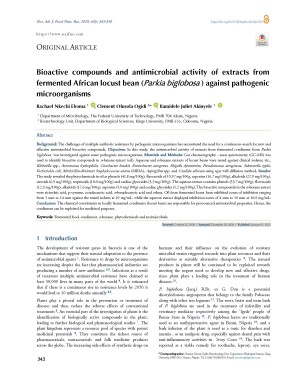
Background: The challenges of multiple antibiotic resistance by pathogenic microorganisms has necessitated the need for a continuous searching for new and effective antimicrobial bioactive compounds. Objectives: In this study, antimicrobial activity of extracts from fermented condiment from Parkia biglobosa was investigated against some pathogenic microorganisms. Materials and Methods: Gas chromatography and mass spectrometry (GC-MS) was used to identify bioactive compounds in n-hexane extract (oil). Aqueous and n-hexane extracts of locust beans were tested against clinical isolates; viz., Klebsiella spp., Aeromonas hydrophilia, Citrobacter braakii, Enterobacter aerogenes, Shigella dysenteriae, Pseudomonas aeruginosa, Salmonella typhi, Escherichia coli, Methicillin Resistant Staphylococcus aureus (MRSA), Aspergillus spp. and Candida albicans using agar well diffusion method. Results: The study revealed the phytochemicals in oil as phenols (41.8 mg/100g), flavonoids of 19.37 mg/100g, saponins (16.7 mg/100g), alkaloids (22.9 mg/100g), steroids (6.9 mg/100g), terpenoids (10.0 mg/100g) and cardiac glycosides (3.3 mg/100g). The aqueous extract contains phenols (33.7 mg/100g), flavonoids (12.3 mg/100g), alkaloids (17.6 mg/100g), saponins (5.0 mg/100g) and cardiac glycosides (1.2 mg/100g). The bioactive compounds in the n-hexane extract were ricinoleic acid, p-cymene, octadecanoic acid, n-hexadecanoic acid and others. Oil from fermented locust bean exhibited zones of inhibition ranging from 5 mm to 14 mm against the tested isolates at 10 mg/mL, while the aqueous extract displayed inhibition zones of 4 mm to 10 mm at 10.0 mg/mL. Conclusion: The chemical constituents in locally fermented condiment (locust bean) are responsible for pronounced antimicrobial properties. Hence, the condiment can be exploited for medicinal purposes.
Keywords
How to Cite
Similar Articles
- Olive stone as a sustainable agricultural by-product: Valorization pathways and prospects in food and feed Industries
- Cyclodextrins for UV Protection in Food, Beverages, and Agricultural Products: A Comprehensive Review
- Study of the relationship between nutrition, physical activity and overweight/obesity in children in a school context: Study of the relationship between nutrition, physical activity
- A review of traditional grain-based complementary foods for children aged 6-23 months in selected African countries
- Food and Water Security in Developing Economies: Impact of Pandemic and Possible Interventions
- Regulation of food supplements in Algeria: Current situation, issues, and perspectives.
- Use and influence of food and nutrition security vulnerability assessment and analysis reports in Zimbabwe
- Efficacy of Moringa Soy Milk as a Food-Based Intervention on Hemoglobin Levels in Anemic Pregnant Women: A Quasi-Experimental Study in Gorontalo, Indonesia
- Polyvinyl Alcohol Films with Algerian Eruca vesicaria Extract as Natural Antioxidants for Food Packaging
- Effects of complementary food formulated from millet, soybean, and grasshopper on hematological parameters of malnourished weanling albino rats
You may also start an advanced similarity search for this article.

 NAJFNR is licensed under