Bioenrichment using Satureja montana L. essential oil for the prevention against photooxidation of flavored extra virgin olive oil during light display
Copyright © 2021 Authors

This work is licensed under a Creative Commons Attribution 4.0 International License.
- Attribution — You must give appropriate credit, provide a link to the license, and indicate if changes were made.
- No additional restrictions — You may not apply legal terms or technological measures that legally restrict others from doing anything the license permits.





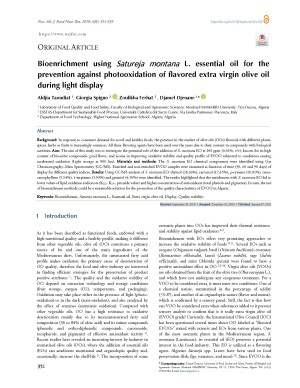
Background: In response to consumer demand for novel and healthy foods, the presence in the market of olive oils (OOs) flavored with different plants, spices, herbs or fruits is increasingly common. All these flavoring agents have been used over the years due to its content in compounds with biological activities. Aim: The aim of this study was to investigate the potential role of the addition of S. montana EO at 100 ppm (0.01%, v/v), known for its high content of bioactive compounds, good flavor, and aroma in improving oxidative stability and quality profile of EVOO subjected to conditions causing accelerated oxidation (Light storage at 900 lux). Materials and methods: The S. montana EO chemical components were identified using Gas Chromatography–Mass Spectrometry (GC/MS). Enriched and non-enriched EVOO samples were examined as function of time (30, 60 and 9 days) of display for different quality indices. Results: Using GC/MS analysis of S. montana EO: thymol (28.36%), carvacrol (17.45%), p-cymene (10.91%), trans-caryophyllene (5.54%), ɤ-terpinene (5.03%) and geraniol (4.50%) were identified. The results highlighted that the enrichment with S. montana EO led to lower values of lipid oxidation indicators (K232, K270, peroxide value) and higher concentration of antioxidants (total phenols and pigments). In sum, the use of bioenrichment methods could be a sustainable solution for the promotion of the quality characteristics of EVOO in Algeria.
Keywords
How to Cite
Similar Articles
- Advantages and Drawbacks of Plant-Based Beverages as Alternatives to Animal Milk: A Multidimensional Review
- Gastronomic heritage of legume foods in Southern Mediterranean cuisine
- Sleep quality and its relationship with climacteric symptoms and quality of life in women on menopausal transition
- Assessing diet quality and its determinants among adults in two Southern Nigerian States
- Effect of peanut-skin fortification on oil separation and consumer acceptance of sesame butter
- Evaluation of Technological Performance of Algerian Soft Wheat Varieties
- Comparative study of total phenolic content and antioxidant proprieties of Quercus fruit: flour and oil
- Influence of Grain Size on the Agglomeration and Quality of Fine Couscous Derived from Decorticated White Sorghum Bicolor L.
- Effects of traditional processing techniques on nutritional quality and sensory acceptability of value-added products made from cowpea (Vigna unguiculata L. walp.) produced in Ethiopia
- Quality of life, perceived stress and nutrition of patients with irritable bowel syndrome: A descriptive study
You may also start an advanced similarity search for this article.

 NAJFNR is licensed under