Update of the nutritional situation in the Republic of the Sudan
Copyright © 2020 Authors

This work is licensed under a Creative Commons Attribution 4.0 International License.
- Attribution — You must give appropriate credit, provide a link to the license, and indicate if changes were made.
- No additional restrictions — You may not apply legal terms or technological measures that legally restrict others from doing anything the license permits.





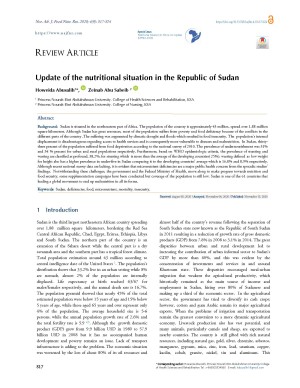
Sudan is situated in the north-eastern part of Africa. The population of the country is approximately 43 million, spread over of 1.88 million square kilometers. Although Sudan has great resources, most of the population suffer from poverty and food deficiency because the conflicts in the different parts of the country .The suffering was augmented by climatic drought and floods which resulted in food insecurity. Internal displacement population are in disadvantage regarding access to health services and are consequently more vulnerable to diseases and malnutrition. In Sudan, thirty-three percent of the population suffered from food deprivation according to national survey of 2010. The prevalence of undernourishment was 31% and 34 % percent for urban and rural populations respectively. Furthermore, based on WHO epidemiologic criteria, the prevalence of stunting and wasting are classified as profound, 38.2%, for stunting which is more than the average of the developing countries( 25%), wasting defined as low weight for height also has a higher prevalence in under-five in Sudan comparing it to the developing countries' average which are 16.8% and 8.9% respectively. Although recent national survey data are lacking, it is evident that micronutrient deficiencies are a major public health concern from the sporadic studies’ findings. Not with standing these challenges, the government and the Federal Ministry of Health, move along to make progress towards nutrition and food security, some supplementation campaigns have been conducted but coverage of the population is still low. Sudan is one of the 61 countries that leading a global movement to end up malnutrition in its all forms.
Keywords
How to Cite
Similar Articles
- The relationship between nutrition screenings and nutritional status determined by malnutrition in hemodialysis patients
- Determination of the mineral profile of raw and roasted lentil flour after addition to yogurt
- Association of socioeconomic status, dietary behavior and obesity among Moroccan adults of the region of Rabat: A case-control study
- Antioxidant activity and polyphenol composition of Pistacia terebinthus fruit from Tessala (Western Algeria)
- Impact of incorporating sesame oil (Sesamum indicum L.) in an Algerian frying oil and margarine formulation
- Evaluation of Hematopoietic and Immune Toxicity in First-Generation (G1) Rats Following Maternal Thiacloprid Exposure During Gestation and Lactation, and the Protective Potential of Bitter Apricot Kernel Extract
- Enhancing food security through scientific research in Algeria. A novel vision and unified national strategy
- In vitro, antioxidant activities of aqueous and methanol roselle (Hibiscus sabdariffa) calyces extracts from two localities in Cameroon
- Effects of traditional processing techniques on nutritional quality and sensory acceptability of value-added products made from cowpea (Vigna unguiculata L. walp.) produced in Ethiopia
- Evaluation of Technological Performance of Algerian Soft Wheat Varieties
You may also start an advanced similarity search for this article.

 NAJFNR is licensed under