Nutrition situation of Burkina Faso: a narrative review
Copyright © 2020 Authors

This work is licensed under a Creative Commons Attribution 4.0 International License.
- Attribution — You must give appropriate credit, provide a link to the license, and indicate if changes were made.
- No additional restrictions — You may not apply legal terms or technological measures that legally restrict others from doing anything the license permits.





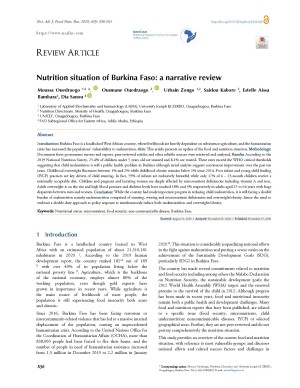
Introduction: Burkina Faso is a landlocked West African country, where livelihoods are heavily dependent on subsistence agriculture, and the humanitarian crisis has increased populations vulnerability to malnutrition. Aim: This article presents an update of the food and nutrition situation. Results: According to the 2019 National Nutrition Survey, 25.4% of children under 5 years old are stunted and 8.1% are wasted. These rates exceed the WHO critical thresholds suggesting that child malnutrition is still a public health problem in Burkina although trend analysis suggests continuous improvement over the past ten years. Childhood overweight fluctuates between 1% and 2% while childhood obesity remains below 1% since 2014. Poor infant and young child feeding (IYCF) practices are key drivers of child stunting. In fact, 59% of infants are exclusively breastfed while only 17% of 6 – 23-month children receive a minimally acceptable diet. Children and pregnant and lactating women are deeply affected by micronutrient deficiencies including vitamin A and iron. Adult overweight is on the rise and high blood pressure and diabetes levels have reached 18% and 5% respectively in adults aged 25 to 64 years with huge disparities between men and women. Conclusion: While the country had made important progress in reducing child malnutrition, it is still facing double burden of malnutrition namely undernutrition comprised of stunting, wasting and micronutrient deficiencies and overweight/obesity, hence the need to embrace a double duty approach to policy response to simultaneously reduce both undernutrition and overweight/obesity.
Keywords
How to Cite
Similar Articles
- Association between meal skipping and the double burden of malnutrition among university students
- Diet, weight status, and physical activity in cancer prevention
- Overview on main nutrition-related diseases in three countries from North Africa
- An overview on the incorporation of novel ingredients on nutritional, textural, and organoleptic properties of gluten-free cereal products
- Zero hunger and malnutrition in the African continent is potentially feasible, if nutrition programs are prioritized politically and scientifically
- Update of the Nutrition Situation in Nigeria
- Assessment of vitamin A levels in breast milk and serum of lactating mothers in Southeast Nigeria
- Enhancing food and nutritional security through Gender-Disaggregated Analysis: A case study of Lake Victoria Shore, Tanzania
- Overview of Food Safety and Labeling Regulatory Frameworks in Morocco
- Nutrient composition of leaves and seeds in selected African Indigenous Vegetables (AIVs): Potential for addressing malnutrition in children under five in Sub-Saharan Africa
You may also start an advanced similarity search for this article.

 NAJFNR is licensed under