Update of the Nutrition Situation in Nigeria
Copyright © 2020 Authors

This work is licensed under a Creative Commons Attribution 4.0 International License.
- Attribution — You must give appropriate credit, provide a link to the license, and indicate if changes were made.
- No additional restrictions — You may not apply legal terms or technological measures that legally restrict others from doing anything the license permits.





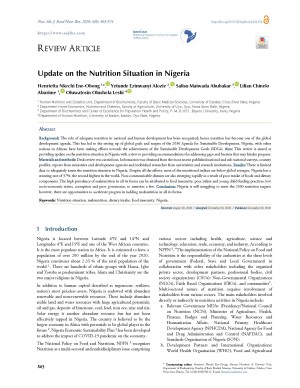
Background: The role of adequate nutrition in national and human development has been recognized; hence nutrition has become one of the global development agenda. This has led to the setting up of global goals and targets of the 2030 Agenda for Sustainable Development. Nigeria, with other nations in African have been making efforts towards the achievement of the Sustainable Development Goals (SDGs). Aim: This review is aimed at providing update on the nutrition situation in Nigeria with a view to providing recommendations for addressing gaps and barriers that may hinder progress. Materials and methods: Desk review was carried out. Information was obtained from the most recent published national and sub-national surveys, country profiles, reports from ministries and development agencies and individual researches from universities and research institutions. Results: There is limited data to adequately assess the nutrition situation in Nigeria. Despite all the efforts, most of the nutritional indices are below global averages. Nigeria has a stunting rate of 37%, the second highest in the world. Non-communicable diseases are also emerging rapidly as a result of poor intake of foods and dietary components. The high prevalence of malnutrition in all its forms can be attributed to food insecurity, poor infant and young child feeding practices, low socio-economic status, corruption and poor governance, to mention a few. Conclusion: Nigeria is still struggling to meet the 2030 nutrition targets; however, there are opportunities to accelerate progress in tackling malnutrition in all its forms.
Keywords
How to Cite
Similar Articles
- Differences in dietary intake between Turkish vegans and omnivores: a cross-sectional study
- Nutritional Quality Assessment and Dietary Diversity of Food in Collective Catering: A Study in Al Hoceima Province, Morocco
- Enhancing food and nutritional security through Gender-Disaggregated Analysis: A case study of Lake Victoria Shore, Tanzania
- Relationship between cultural food taboos and maternal and child nutrition: A systematic literature review
- Nutritional Status and Beverage Intake Patterns among Civil Servants in Southwestern Nigeria
- An Observational Study on the Use of Manual Muscle Testing for Dietary Elimination in Food Sensitivity-Related Conditions
- Assessment of energy and nutrient intake adequacy and dietary diversity of pregnant women in Abidjan
- Impact of care group participation on nutrition knowledge, behaviour and practices
- Use and influence of food and nutrition security vulnerability assessment and analysis reports in Zimbabwe
- Determinants of malnutrition and associated parameters in subjects with stable chronic obstructive pulmonary disease: A cross sectional study
You may also start an advanced similarity search for this article.

 NAJFNR is licensed under