Mediterranean diet and food consumption in an urban adult population of Northwest Algeria
Copyright © 2020 Authors

This work is licensed under a Creative Commons Attribution 4.0 International License.
- Attribution — You must give appropriate credit, provide a link to the license, and indicate if changes were made.
- No additional restrictions — You may not apply legal terms or technological measures that legally restrict others from doing anything the license permits.





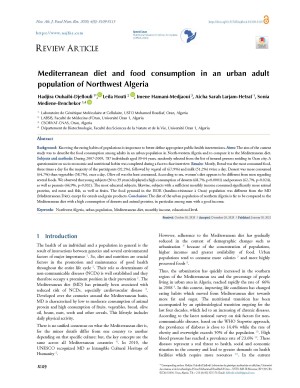
Background: Knowing the eating habits of populations is important to better define appropriate public health interventions. Aims: The aim of the current study was to describe the food consumption among adults in an urban population in North-western Algeria and to compare it to the Mediterranean diet. Subjects and methods: During 2007-2009, 787 individuals aged 30-64 years, randomly selected from the list of insured persons residing in Oran city. A questionnaire on socio-economic and nutritional habits was completed during a face-to-face interview. Results: Mostly, Bread was the most consumed food, three times a day for the majority of the participants (92.2%), followed by vegetal oil (67.9%) and milk (51.2%) twice a day. Dessert was more consumed (64.7%) than vegetables (58.7%), once a day. Olive oil was the least consumed. According to sex, women’s diet appears to be different from men regarding several foods. We observed that young subjects (30 to 39 years) displayed a high consumption of desserts (68.7%, p<0.0001) and potatoes (62.7%, p=0.024), as well as peanuts (44.9%, p=0.032). The most educated subjects, likewise, subjects with a sufficient monthly income consumed significantly more animal proteins, red meat and fish, as well as fruits. The food pyramid in the ISOR (Insulino-résistance à Oran) population was different from the MD (Mediterranean Diet), except for cereals and grain products. Conclusion: The diet of the urban population of northern Algeria is far to be compared to the Mediterranean diet with a high consumption of desserts and animal proteins, in particular among men with a good income.
Keywords
How to Cite
Similar Articles
- Nutritional Status, Muscle Mass, and Body Fat Percentage in Patients with Breast Cancer Undergoing Adjuvant Chemotherapy
- Understanding Bread Consumption and Waste Patterns in Algeria and Tunisia: Insights into Consumer Practices and Challenges
- Update of the nutritional situation in the Republic of the Sudan
- An overview on the nutrition transition and its health implications: Tunisia case
- Micronutrient supplementation among pregnant women in western Algeria
- Antioxidant activity and polyphenol composition of Pistacia terebinthus fruit from Tessala (Western Algeria)
- Effect of healthy lifestyle promotion on anthropometric variables, eating behavior and cardiometabolic risk factors in women with polycystic ovarian syndrome
- Zero hunger and malnutrition in the African continent is potentially feasible, if nutrition programs are prioritized politically and scientifically
- Nutritional knowledge and behavior of a sample of Algerian pregnant women
- Effects of complementary food formulated from millet, soybean, and grasshopper on hematological parameters of malnourished weanling albino rats
You may also start an advanced similarity search for this article.

 NAJFNR is licensed under