Update of the nutritional situation in Benin Republic
Copyright © 2020 Authors

This work is licensed under a Creative Commons Attribution 4.0 International License.
- Attribution — You must give appropriate credit, provide a link to the license, and indicate if changes were made.
- No additional restrictions — You may not apply legal terms or technological measures that legally restrict others from doing anything the license permits.





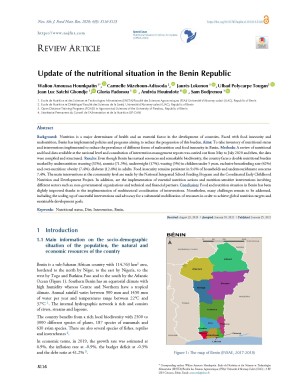
Background: Nutrition is a major determinant of health and an essential factor in the development of countries. Faced with food insecurity and malnutrition, Benin has implemented policies and programs aiming to reduce the progression of this burden. Aims: To take inventory of nutritional status and interventions implemented to reduce the prevalence of different forms of malnutrition and food insecurity in Benin. Methods: A review of nutritional and food data available at national level and consultation of intervention management reports was carried out from May to July 2020 and then, the data were compiled and structured. Results: Even though Benin has natural resources and remarkable biodiversity, the country faces a double nutritional burden marked by undernutrition: stunting (32%), anemia (71.5%), underweight (17%), wasting (5%) in children under 5 years, exclusive breastfeeding rate (42%) and over-nutrition: obesity (7.4%), diabetes (12.4%) in adults. Food insecurity remains persistent in 9.6% of households and undernourishment concerns 7.4%. The main interventions at community level are made by the National Integrated School Feeding Program and the Coordinated Early Childhood Nutrition and Development Project. In addition, are the implementation of essential nutrition actions and nutrition-sensitive interventions involving different sectors such as, non-governmental organizations and technical and financial partners. Conclusion: Food and nutrition situation in Benin has been slightly improved thanks to the implementation of multisectoral coordination of interventions. Nonetheless, many challenges remain to be addressed, including the scaling up of successful interventions and advocacy for a substantial mobilization of resources in order to achieve global nutrition targets and sustainable development goals.
Keywords
How to Cite
Similar Articles
- Overview on main nutrition-related diseases in three countries from North Africa
- Nutritional Status, Muscle Mass, and Body Fat Percentage in Patients with Breast Cancer Undergoing Adjuvant Chemotherapy
- Calcium status in Moroccan children and adolescents assessed by 24-hour urinary excretion
- Assessment of vitamin A levels in breast milk and serum of lactating mothers in Southeast Nigeria
- Food profile and its effect on the occurrence of diabetes in patients living with HIV: A cross-sectional study at the Nylon district hospital, Cameroon
- Effect of healthy lifestyle promotion on anthropometric variables, eating behavior and cardiometabolic risk factors in women with polycystic ovarian syndrome
- Zero hunger and malnutrition in the African continent is potentially feasible, if nutrition programs are prioritized politically and scientifically
- Dietary patterns and nutrient intake of pregnant women in Afijio and Oyo East Local Government areas of Oyo State, Nigeria
- Nutrition situation of Burkina Faso: a narrative review
- Evaluation of Nutritional Status Among COVID-19 Patients Admitted to the Intensive Care Unit in Jeddah, Saudi Arabia: A Cross-Sectional Observational Study
You may also start an advanced similarity search for this article.

 NAJFNR is licensed under