Food profile and its effect on the occurrence of diabetes in patients living with HIV: A cross-sectional study at the Nylon district hospital, Cameroon
Copyright © 2021 Authors

This work is licensed under a Creative Commons Attribution 4.0 International License.
- Attribution — You must give appropriate credit, provide a link to the license, and indicate if changes were made.
- No additional restrictions — You may not apply legal terms or technological measures that legally restrict others from doing anything the license permits.





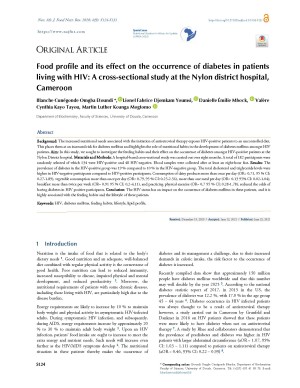
Background: The increased nutritional needs associated with the initiation of antiretroviral therapy exposes HIV-positive patients to an uncontrolled diet. This places them at an increased risk for diabetes mellitus and highlights the role of nutritional habits in the development of diabetes mellitus amongst HIV patients. Aim: In this study, we sought to investigate the feeding habits and their effect on the occurrence of diabetes amongst HIV-positive patients at the Nylon District hospital. Material and Methods: A hospital-based cross-sectional study was carried out over eight months. A total of 182 participants were randomly selected of which 134 were HIV-positive and 48 HIV-negative. Blood samples were collected after at least an eight-hour fast. Results: The prevalence of diabetes in the HIV-positive group was 19 % compared to 10 % in the HIV-negative group. The total cholesterol and triglyceride levels were higher in HIV-negative participants compared to HIV-positive participants. Consumption of dairy products more than once per day (OR= 0.71, 95 % CI: 0.27-1.89), vegetable consumption more than once per day (OR= 0.79, 95 % CI: 0.25-2.56), more than one meal per day (OR= 0.13 95% CI: 0.02-1.04), breakfast more than twice per week (OR= 0.91 95 % CI: 0.2-4.11), and practicing physical exercise (OR= 0.7 95 % CI: 0.28-1.78), reduced the odds of having diabetes in HIV positive participants. Conclusion: The HIV status has an impact on the occurrence of diabetes mellitus in these patients, and it is highly associated with the feeding habits and the lifestyle of these patients.
Keywords
How to Cite
Similar Articles
- Epidemiology, diagnosis, and assessment of diabetes mellitus in the elderly population: a purposive review
- Statistical study of the relationship between hyperuricemia, dyslipidemia and type 2 diabetes in rural population of Tizi-Ouzou, Algeria
- Prevalence of Peptic Ulcer Disease and Dietary Pattern among Students of a Private University in Nigeria
- The Association Between Perceived Stress, Lifestyle and Dietary Behaviors, and Hypertension Among University Personnel
- Physicochemical characteristics and nutritional value of safflower oil: A potential sustainable crop for Egypt
- Comparison of lifestyle patterns and body weight management practices between normal weight and obese female university students (Riyadh – Saudi Arabia)
- Rapid survey on lifestyle changes and body weight gain among Algerians during COVID-19 lockdown
- Impact of food security, dietary diversity, and nutritional status on glycemic control among adults with type 2 diabetes mellitus in Fako Division, Cameroon
- Adherence to the Mediterranean Diet and anthropometric profile of obese Algerian subjects
- Prevalence of prediabetes in an urban Nigerian population using the Finnish Diabetes Risk Score.
You may also start an advanced similarity search for this article.

 NAJFNR is licensed under