COVID-19 lockdown impact on Tunisian consumer behaviors and awareness related to food consumption and wastage during celebrations: Case of study “Ramadan month”
Copyright © 2022 Hanen Ben Ismail, Sarra Jribi, Darine Doggui, Hajer Debbabi

This work is licensed under a Creative Commons Attribution 4.0 International License.
- Attribution — You must give appropriate credit, provide a link to the license, and indicate if changes were made.
- No additional restrictions — You may not apply legal terms or technological measures that legally restrict others from doing anything the license permits.





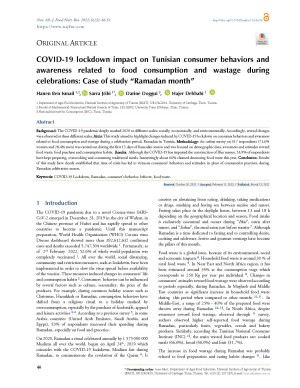
Background: The COVID-19 pandemic deeply marked 2020 at different scales: socially, economically, and environmentally. Accordingly, several changes were observed at these different scales. Aims: This study aimed to highlight changes induced by COVID-19 lockdown on consumer behaviors and awareness related to food consumption and wastage during a celebration period, Ramadan in Tunisia. Methodology: An online survey on 317 respondents (71.6% women and 28.4% men) was carried out during the first 15 days of Ramadan season and was focused on demographic data, awareness and attitudes toward food waste, food purchase and consumption habits. Results: Although the COVID-19 has impaired the construction of Iftar menus, 53.9% of respondents have kept preparing, overcooking and consuming traditional meals. Interestingly about 66% claimed decreasing food waste this year. Conclusion: Results of this study have clearly established that time of crisis has led to virtuous consumers’ behaviors and attitudes, in place of consumerist practices, during Ramadan celebration season.
Keywords
How to Cite
Similar Articles
- Nutritional Quality Assessment and Dietary Diversity of Food in Collective Catering: A Study in Al Hoceima Province, Morocco
- Nutrient composition of leaves and seeds in selected African Indigenous Vegetables (AIVs): Potential for addressing malnutrition in children under five in Sub-Saharan Africa
- Study of the relationship between nutrition, physical activity and overweight/obesity in children in a school context: Study of the relationship between nutrition, physical activity
- Effect of peanut-skin fortification on oil separation and consumer acceptance of sesame butter
- Cyclodextrins for UV Protection in Food, Beverages, and Agricultural Products: A Comprehensive Review
- Evaluation of Nutritional Status Among COVID-19 Patients Admitted to the Intensive Care Unit in Jeddah, Saudi Arabia: A Cross-Sectional Observational Study
- Traditional Tunisian Pasta "Nwasser" Enriched with Wheat Bran: Impact on Physicochemical Quality, Nutritional Profile, and Acute Post-Prandial Glycemic Response in Healthy Individuals
- Hepatorenal and Cerebral Toxicity Induced by Consumption of Cow Meat Singed with Scrap Tyres: An Experimental Study in a Rat Model
- Nutritional knowledge and behavior of a sample of Algerian pregnant women
- Sleep quality and its relationship with climacteric symptoms and quality of life in women on menopausal transition
You may also start an advanced similarity search for this article.
Most read articles by the same author(s)
- An overview on the incorporation of novel ingredients on nutritional, textural, and organoleptic properties of gluten-free cereal products
- Partial substitution of sucrose by non-nutritive sweeteners in sour orange marmalades: effects on quality characteristics and acute postprandial glycemic response in healthy volunteers
- Understanding Bread Consumption and Waste Patterns in Algeria and Tunisia: Insights into Consumer Practices and Challenges
- Editorial from the new Editor-in-Chief and the new Executive Deputy Editors-in-Chief
- Sprouting bioprocess as a sustainable tool for enhancing durum wheat (Triticum durum) nutrients and bioactive compounds
- Traditional Tunisian Pasta "Nwasser" Enriched with Wheat Bran: Impact on Physicochemical Quality, Nutritional Profile, and Acute Post-Prandial Glycemic Response in Healthy Individuals

 NAJFNR is licensed under