Body composition, energy expenditure, and markers of hemolysis in adults with sickle cell disease
Copyright © 2022 Karen Cordovil, Marise Crivelli, Flávia dos Santos Barbosa Brito, Marcos Fleury

This work is licensed under a Creative Commons Attribution 4.0 International License.
- Attribution — You must give appropriate credit, provide a link to the license, and indicate if changes were made.
- No additional restrictions — You may not apply legal terms or technological measures that legally restrict others from doing anything the license permits.





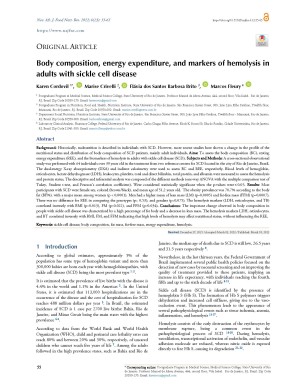
Background: Historically, malnutrition is described in individuals with SCD. However, more recent studies have shown a change in the profile of the nutritional status and distribution of body composition of SCD patients, mainly adult individuals. Aims: To assess the body composition (BC), resting energy expenditure (REE), and the biomarkers of hemolysis in adults with sickle cell disease (SCD). Subjects and Methods: A cross-sectional observational study was performed with 64 individuals over 39 years old in the treatment from two reference centers for SCD located in the city of Rio de Janeiro, Brazil. The dual-energy X-ray absorptiometry (DXA) and indirect calorimetry were used to assess BC and REE, respectively. Blood levels of hemoglobin, reticulocytes, lactate dehydrogenase (LDH), leukocytes, platelets, total and direct bilirubin, total protein, and albumin were measured to assess the hemolysis and protein status. The descriptive and inferential analysis was composed of the different methods (one-way ANOVA with the multiple comparison test of Tukey, Student t-test, and Pearson's correlation coefficient). Were considered statistically significant when the p-values were ≤ 0.05. Results: Most participants with SCD were female sex, colored (brown/black), and mean age of 51.2 years old. The obesity prevalence was 70.7% according to the body fat (BF%), with a major mean among women (p < 0.0001). Men had a higher mean of lean mass (LM) (p=0.0005) and fat-free mass (FFM) (p=0.0007). There was no difference for REE in comparing the genotypes (p= 0.53), and genders (p=0.075). The hemolysis markers (LDH, reticulocytes, and TB) correlated inversely with BMI (p=0.013), FM (p=0.022), and FFM (p=0.034). Conclusions: The important change observed in body composition in people with sickle cell disease was characterized by a high percentage of fat body and a decrease in lean mass. The hemolysis markers LDH, reticulocytes, and BT correlated inversely with BMI, FM, and FFM indicating that high levels of hemolysis may affect nutritional status, without influencing the REE.
Keywords
How to Cite
Similar Articles
- An overview on the incorporation of novel ingredients on nutritional, textural, and organoleptic properties of gluten-free cereal products
- Relationship between intake of energy-dense diets and nutritional status of adolescents in primary schools in Nairobi City County, Kenya
- Nutrient composition of leaves and seeds in selected African Indigenous Vegetables (AIVs): Potential for addressing malnutrition in children under five in Sub-Saharan Africa
- Prevalence of Peptic Ulcer Disease and Dietary Pattern among Students of a Private University in Nigeria
- Physicochemical quality assessment of Brazilian frozen beef imported into Algeria
- Physical properties and chemical composition of three Ethiopian rice (Oryza sativa Linn.) varieties compared to tef [Eragrostis tef (Zucc.) Trotter] grain
- Rapid survey on lifestyle changes and body weight gain among Algerians during COVID-19 lockdown
- Effect of polysaccharide-coatings on the physicochemical properties and nutritional composition of deep-fried chicken breasts
- Socioeconomic and Demographic Correlates of Nutritional Status in Elderly Urban Dwellers of Havana, Cuba
- Physicochemical characterization and antioxidant capacity of the extracted oil from date pits and its effect on storage stability of margarine
You may also start an advanced similarity search for this article.

 NAJFNR is licensed under