An overview on the incorporation of novel ingredients on nutritional, textural, and organoleptic properties of gluten-free cereal products
Copyright © 2022 Wafa Allouch, Dorra Sfayhi, Leila Doggui , Hajer Debbabi

This work is licensed under a Creative Commons Attribution 4.0 International License.
- Attribution — You must give appropriate credit, provide a link to the license, and indicate if changes were made.
- No additional restrictions — You may not apply legal terms or technological measures that legally restrict others from doing anything the license permits.





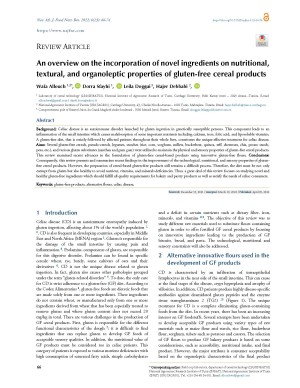
Background: Celiac disease is an autoimmune disorder launched by gluten ingestion in genetically susceptible persons. This component leads to an inflammation of the small intestine which causes malabsorption of some important nutrients including calcium, iron, folic acid, and liposoluble vitamins. A gluten-free diet, that is strictly followed by affected patients throughout their whole lives, constitutes the unique effective treatment for celiac disease. Aims: Several gluten-free cereals, pseudo-cereals, legumes, starches (rice, corn, sorghum, millets, buckwheat, quinoa, teff, chestnuts, chia, potato starch, peas, etc.), and various gluten substitutes (xanthan and gum guar) were utilized to maintain the physical and sensory properties of gluten-free cereal products. This review examined recent advances in the formulation of gluten-free cereal-based products using innovative gluten-free flours. Conclusions: Consequently, this review presents and summarizes recent findings in the improvement of the technological, nutritional, and sensory properties of gluten-free cereal products. However, the preparation of cereal-based gluten-free products still remains a difficult process. Therefore, the diet must be not only exempt from gluten but also healthy to avoid nutrient, vitamins, and minerals deficiencies. Thus, a great deal of this review focuses on studying novel and healthy gluten-free ingredients which should fulfill all quality requirements for bakery and pastry products as well as satisfy the needs of celiac consumers.
Keywords
How to Cite
Similar Articles
- Glutamine and sickle cell disease in Brazilian scenario
- Sprouting bioprocess as a sustainable tool for enhancing durum wheat (Triticum durum) nutrients and bioactive compounds
- Anti-inflammatory activity of doum palm fruit extract used in the management of benign prostatic hyperplasia
- Quality of life, perceived stress and nutrition of patients with irritable bowel syndrome: A descriptive study
- Cross‐sectional association between lifestyle behavior and cardiometabolic biomarkers in west Algerian postmenopausal women
- Editorial introduction to the first issue
- In vitro, antioxidant activities of aqueous and methanol roselle (Hibiscus sabdariffa) calyces extracts from two localities in Cameroon
- Statistical study of the relationship between hyperuricemia, dyslipidemia and type 2 diabetes in rural population of Tizi-Ouzou, Algeria
- Evaluation of Nutritional Status Among COVID-19 Patients Admitted to the Intensive Care Unit in Jeddah, Saudi Arabia: A Cross-Sectional Observational Study
- Nutrition situation of Burkina Faso: a narrative review
You may also start an advanced similarity search for this article.
Most read articles by the same author(s)
- Partial substitution of sucrose by non-nutritive sweeteners in sour orange marmalades: effects on quality characteristics and acute postprandial glycemic response in healthy volunteers
- Understanding Bread Consumption and Waste Patterns in Algeria and Tunisia: Insights into Consumer Practices and Challenges
- COVID-19 lockdown impact on Tunisian consumer behaviors and awareness related to food consumption and wastage during celebrations: Case of study “Ramadan month”
- Editorial from the new Editor-in-Chief and the new Executive Deputy Editors-in-Chief
- Sprouting bioprocess as a sustainable tool for enhancing durum wheat (Triticum durum) nutrients and bioactive compounds
- Traditional Tunisian Pasta "Nwasser" Enriched with Wheat Bran: Impact on Physicochemical Quality, Nutritional Profile, and Acute Post-Prandial Glycemic Response in Healthy Individuals

 NAJFNR is licensed under