Determination of isoflavones from soy-milk, masoor and mung dal soups in Bangladeshi postmenopausal women
Copyright © 2018 Authors

This work is licensed under a Creative Commons Attribution 4.0 International License.
- Attribution — You must give appropriate credit, provide a link to the license, and indicate if changes were made.
- No additional restrictions — You may not apply legal terms or technological measures that legally restrict others from doing anything the license permits.





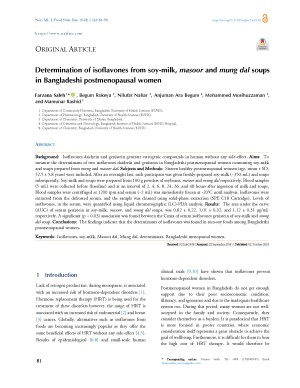
Background: Isoflavones daidzein and genistein generate estrogenic compounds in human without any side-effect. Aims: To measure the determinants of two isoflavones daidzein and genistein in Bangladeshi postmenopausal women consuming soy-milk and soups prepared from mung and masoor dal. Methods and Material: Sixteen healthy postmenopausal women (age, mean±SD, 52.5±5.8 years) were included. After an overnight fast, each participant was given freshly-prepared soy-milk (~350-mL) and soups subsequently. Soy-milk and soups were prepared from 100 g powders of soybeans, masoor and mung dal respectively. Blood samples (5 mL) were collected before (baseline) and at an interval of 2, 4, 6, 8, 24, 36, and 48 hours after ingestion of milk and soups. Blood samples were centrifuged at 1200 rpm and serum (~2 mL) was immediately frozen at -20°C until analysis. Isoflavones were extracted from the defrosted serum, and the sample was cleaned using solid-phase extraction (SPE C18 Cartridge). Levels of isoflavones, in the serum, were quantified using liquid chromatographic (LC)-PDA analysis. Results: The area under the curve (AUC) of serum genistein in soy-milk, masoor, and mung dal soups, was 0.82 ±0.22, 1.01 ±0.32, and 1.12 ±0.31 µg/mL respectively. A significant (P= 0.03) association was found between the Cmax of serum isoflavones genistein of soy-milk and mung dal soup. Conclusions: The findings indicate that the determinants of isoflavones was found in non-soy foods among Bangladeshi postmenopausal women. Isoflavones daidzein and genistein generate estrogenic compounds in human without any side-effect. Aims: To measure the determinants of two isoflavones daidzein and genistein in Bangladeshi postmenopausal women consuming soy-milk and soups prepared from mung and masoor dal. Methods and Material: Sixteen healthy postmenopausal women (age, mean±SD, 52.5±5.8 years) were included. After an overnight fast, each participant was given freshly-prepared soy-milk (~350-mL) and soups subsequently. Soy-milk and soups were prepared from 100 g powders of soybeans, masoor and mung dal respectively. Blood samples (5 mL) were collected before (baseline) and at an interval of 2, 4, 6, 8, 24, 36, and 48 hours after ingestion of milk and soups. Blood samples were centrifuged at 1200 rpm and serum (~2 mL) was immediately frozen at -20°C until analysis. Isoflavones were extracted from the defrosted serum, and the sample was cleaned using solid-phase extraction (SPE C18 Cartridge). Levels of isoflavones, in the serum, were quantified using liquid chromatographic (LC)-PDA analysis. Results: The area under the curve (AUC) of serum genistein in soy-milk, masoor, and mung dal soups, was 0.82 ±0.22, 1.01 ±0.32, and 1.12 ±0.31 µg/mL respectively. A significant (P= 0.03) association was found between the Cmax of serum isoflavones genistein of soy-milk and mung dal soup. Conclusions: The findings indicate that the determinants of isoflavones was found in non-soy foods among Bangladeshi postmenopausal women.
Keywords
How to Cite
Similar Articles
- Advantages and Drawbacks of Plant-Based Beverages as Alternatives to Animal Milk: A Multidimensional Review
- Quality of life, perceived stress and nutrition of patients with irritable bowel syndrome: A descriptive study
- Cross‐sectional association between lifestyle behavior and cardiometabolic biomarkers in west Algerian postmenopausal women
- Investigation of total aflatoxin in nuts and dried fruits and consumption habits during pregnancy in Türkiye
- Development of ready-to-serve pineapple juice with coconut milk
- Effect of healthy lifestyle promotion on anthropometric variables, eating behavior and cardiometabolic risk factors in women with polycystic ovarian syndrome
- Micronutrient supplementation among pregnant women in western Algeria
- The effect of giving combination boiled chicken egg and red dragon fruit (Hylocereus polyrhizus) to increase hemoglobin levels in women during menstruation
- Prevalence of anemia, hematocrit variations, and micronutrient supplementation practices among pregnant women attending antenatal clinics in Ibadan, Southwest Nigeria
- Relationship between cultural food taboos and maternal and child nutrition: A systematic literature review
You may also start an advanced similarity search for this article.

 NAJFNR is licensed under