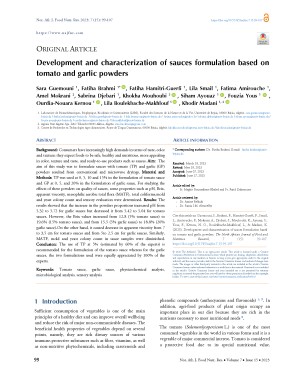
Development and characterization of sauces formulations based on tomato and garlic powders
Copyright © 2023 Sara Guemouni, Fatiha Brahmi, Fatiha Hamitri-Guerfi, Lila Smail, Fatima Amirouche, Amel Mokrani, Sabrina Djebari, Khoukha Mouhoubi, Siham Ayouaz, Fouzia Yous, Ourdia-Nouara Kernou, Lila Boulekbache-Makhlouf, Khodir Madani

This work is licensed under a Creative Commons Attribution 4.0 International License.
- Attribution — You must give appropriate credit, provide a link to the license, and indicate if changes were made.
- No additional restrictions — You may not apply legal terms or technological measures that legally restrict others from doing anything the license permits.





Background: Consumers have increasingly high demands in terms of taste, color and texture; they expect foods to be safe, healthy and nutritious, more appealing in color, texture and taste, and ready-to-use products such as sauces. Aim: The aim of this study was to formulate sauces with tomato (TP) and garlic (GP) powders resulted from conventional and microwave dryings. Material and Methods: TP was used at 0, 5, 10 and 15% in the formulation of tomato sauce and GP at 0, 5, and 20% in the formulation of garlic sauce. For studying the effects of these powders on quality of sauces, some properties such as pH, Brix, apparent viscosity, mesophilic aerobic total flora (MATF), total coliforms,mold and yeast colony count and sensory evaluation were determined. Results: The results showed that the increase in the powders proportions increased pH from 5.32 to 5.72 for garlic sauces but decreased it from 5.42 to 5.04 for tomato sauces. However, the Brix values increased from 12.8 (5% tomato sauce) to 19.6% (15% tomato sauce), and from 15.5 (5% garlic sauce) to 18.8% (20% garlic sauce).On the other hand, it caused decrease in apparent viscosity from 7 to 3.5 cm for tomato sauces and from 5to 2.5 cm for garlic sauces. Similarly, MATF, mold and yeast colony count in sauce samples were diminished. Conclusion: The use of TP at 5% (estimated by 60% of the experts) is recommended for the formulation of the tomato sauce whereas for the garlic sauces, the two formulations used were equally appreciated by 100% of the experts.
How to Cite
Most read articles by the same author(s)
- Emerging trends in coffee consumption among university students in Béjaïa, Algeria
- Inactivation of E. faecalis under microwave heat treatment and ultrasound probe
- Supplementation species effect on the phenolic content and biological bioactivities of the decocted green tea
- Simultaneous Determination of Acrylamide, Caffeic Acid, and Caffeine in Commercial Coffee Capsules Using a Rapid and Validated HPLC-DAD Approach

 NAJFNR is licensed under