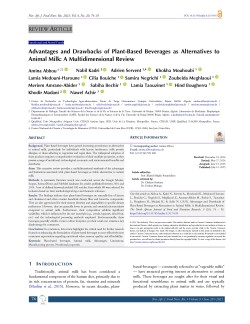
Advantages and Drawbacks of Plant-Based Beverages as Alternatives to Animal Milk: A Multidimensional Review
Copyright © 2025 Amina Abbou, Nabil Kadri, Adrien Servent, Khokha Mouhoubi, Lamia Medouni, Cilia Bouiche, Samira Negrichi, Zoubeida Meghlaoui, Meriem Amrane, Sabiha Bechir, Lamia Taouzinet, Hind Bougherra, Khodir Madani, Nawel Achir

This work is licensed under a Creative Commons Attribution 4.0 International License.
- Attribution — You must give appropriate credit, provide a link to the license, and indicate if changes were made.
- No additional restrictions — You may not apply legal terms or technological measures that legally restrict others from doing anything the license permits.





Background: Plant-based beverages have gained increasing prominence as alternatives to animal milk, particularly for individuals with lactose intolerance, milk protein allergies, or those adhering to vegetarian and vegan diets. The widespread adoption of these products requires a comprehensive evaluation of their multiple properties, as they possess a range of nutritional, technological, economic, and environmental benefits and drawbacks.
Aims: This narrative review provides a multidimensional synthesis of the advantages and limitations associated with plant-based beverages as viable alternatives to animal milk.
Methods: A systematic literature search was conducted across the Google Scholar, Scopus, ScienceDirect and PubMed databases for articles published between 2010 and 2024. A set of defined keywords yielded 183 articles, from which 68 were selected for inclusion based on their methodological rigor and thematic relevance.
Results: The findings indicate that plant-based beverages are naturally free of lactose and cholesterol and often contain beneficial dietary fiber and bioactive compounds. They are also appreciated for their sensory diversity and adaptability to specific dietary preferences. However, they are generally lower in protein and essential micronutrients compared to animal milk. Furthermore, their composition exhibits significant variability, which is influenced by the raw materials (e.g., cereals, legumes, dried fruit, etc.) and the technological processing methods employed. Environmentally, these beverages generally exhibit a lower carbon footprint, yet their retail cost remains a key disadvantage for consumers.
Conclusions: In conclusion, this review highlights the critical need for further research focused on enhancing the formulation of plant-based beverages to more effectively meet consumers expectations regarding nutritional value, sensory quality, and affordability.
Keywords
How to Cite
https://doi.org/10.3390/molecules25040927
Ahmadian-Kouchaksaraei, Z., Varidi, M., Varidi, M. J., & Pourazarang, H. (2014). Influence of processing conditions on the physicochemical and sensory properties of sesame milk: A novel nutritional beverage. Lebensmittel-Wissenschaft Und Technologie Food Science and Technology, 57(1), 299–305. https://doi.org/10.1016/j.lwt.2013.12.028
Ali, A. M., Waheed, A., Shahbaz, M., Mirani, A. A., Shahzad, K., Al-Zahrani, A. A., Nawaz, A. M., & Mahpudz, A. B. (2023). Synergistic evaluation of co-torrefaction performance of rice husk and coffee bean ground blends for biosolid production for industrial fuel sustainability. Fuel (London, England), 343(127891), 127891. https://doi.org/10.1016/j.fuel.2023.127891
Anema, S. G. (2019). Age gelation, sedimentation, and creaming in UHT milk: A review. Comprehensive Reviews in Food Science and Food Safety, 18(1), 140–166. https://doi.org/10.1111/1541-4337.12407
Arbab Sakandar, H., Chen, Y., Peng, C., Chen, X., Imran, M., & Zhang, H. (2021). Impact of fermentation on antinutritional factors and protein degradation of legume seeds: A review. Food Reviews International, 1–23. https://doi.org/10.1080/87559129.2021.1931300
Aschemann-Witzel, J., & Peschel, A. O. (2019). How circular will you eat? The sustainability challenge in food and consumer reaction to either waste-to-value or yet underused novel ingredients in food. Food Quality and Preference, 77, 15–20. https://doi.org/10.1016/j.foodqual.2019.04.012
Atwaa, E., Elmaadawy, A., & Awaad, E. (2019). Production of fruit flavored probiotic rice milk beverage. Journal of Food and Dairy Sciences, 10(12), 453–458. https://doi.org/10.21608/jfds.2019.71360
Aydar, E. F., Mertdinç, Z., Demircan, E., Koca Çetinkaya, S., & Özçelik, B. (2023). Kidney bean (Phaseolus vulgaris L.) milk substitute as a novel plant-based drink: Fatty acid profile, antioxidant activity, in-vitro phenolic bio-accessibility and sensory characteristics. Innovative Food Science & Emerging Technologies: IFSET: The Official Scientific Journal of the European Federation of Food Science and Technology, 83, 103254. https://doi.org/10.1016/j.ifset.2022.103254
Aydar, E. F., Tutuncu, S., & Ozcelik, B. (2020). Plant-based milk substitutes: Bioactive compounds, conventional and novel processes, bioavailability studies, and health effects. Journal of Functional Foods, 70, 103975. https://doi.org/10.1016/j.jff.2020.103975
Basinskiene, L., & Cizeikiene, D. (2020). Cereal-based nonalcoholic beverages. In Trends in Non-alcoholic Beverages (pp. 63–99). Elsevier.
Similar Articles
- Anthropometric, dietary, and nutritional outcomes of vegetarian and vegan diets in childhood: A narrative review and recommendations for adequate nutrition
- Assessment of vitamin A levels in breast milk and serum of lactating mothers in Southeast Nigeria
- Critical evaluation of the discrepancy between whole and refined foods: nutritional implications
- Effect of incorporating Lippia javanica (Zumbani) on physical, nutritional, microbiological, and sensory properties of instant soup mix powder
- Enhancing Freshwater Fish Consumption in Algeria: A Study on the Nutritional and Sensory Attributes of Common Carp Sticks
- Determination of nutrient composition of some selected traditional home- made meals commonly consumed in Syria
- Nutritional evaluation, oxidative indexes, and functional properties of Irish potatoes, eggs, and red kidney beans based complementary food
- Diet, weight status, and physical activity in cancer prevention
- Proximate analysis of selected agricultural waste for their nutritional potential
- Antibacterial and antihemolytic assessment of Allium sativum through optimized protein fraction extraction
You may also start an advanced similarity search for this article.
Most read articles by the same author(s)
- Impact of carob (Ceratonia Ciliqua L) pulp flour supplementation on probiotic viability, milk fermentation and antioxidant capacity during yogurt storage
- Ziziphus lotus (L.) Lam. plant treatment by ultrasounds and microwaves to improve antioxidants yield and quality: An overview
- Anticarcinogenic and antioxidant activities of leaves and flowers hydroalcoholic extracts of Nerium oleander L.: PCA analysis and phytochemical content by FTIR spectroscopy
- Development and characterization of sauces formulations based on tomato and garlic powders
- Impact of incorporating sesame oil (Sesamum indicum L.) in an Algerian frying oil and margarine formulation
- Microwave-assisted extraction optimization and conventional extraction of phenolic compounds from coriander leaves: UHPLC characterization and antioxidant activity
- Study of the relationship between nutrition, physical activity and overweight/obesity in children in a school context: Study of the relationship between nutrition, physical activity
- Ultrasound as pre-treatment for microwave drying of Myrtus communis fruits: Influence on phenolic compounds and antioxidant activity
- Physicochemical characterization and antioxidant capacity of the extracted oil from date pits and its effect on storage stability of margarine
- Modeling of nitrate leaching kinetics during spinach leaf midribs blanching

 NAJFNR is licensed under