Evaluation of Technological Performance of Algerian Soft Wheat Varieties
Copyright © 2025 Lynda Messaoudene, Amina Belguendouze , Lamia Medouni-Haroune, Samira Negrichi, Mohamed Khalil Mellal

This work is licensed under a Creative Commons Attribution 4.0 International License.
- Attribution — You must give appropriate credit, provide a link to the license, and indicate if changes were made.
- No additional restrictions — You may not apply legal terms or technological measures that legally restrict others from doing anything the license permits.





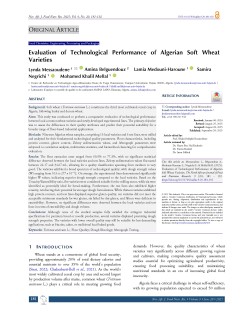
Background: Soft wheat (Triticum aestivum L.) constitutes the third most cultivated cereal crop in Algeria, following barley and durum wheat.
Aims: This study was conducted to perform a comparative evaluation of technological performance between local common wheat varieties and newly developed experimental lines. The primary objective was to assess the differences in their quality attributes and predict their potential suitability for a broader range of flour-based industrial applications.
Methods: Nineteen Algerian wheat samples, comprising 13 local varieties and 6 test lines, were milled and analyzed for their fundamental technological quality parameters. Flour characteristics, including protein content, gluten content, Zeleny sedimentation values, and Alveograph parameters were subjected to correlation analysis, multivariate statistics, and hierarchical clustering for comprehensive evaluation.
Results: The flour extraction rates ranged from 60.9% to 77.3%, with no significant statistical difference observed between the local varieties and test lines. Zeleny sedimentation values fluctuated between 22.17 and 34.67 mL, allowing for a quality classification spanning from medium to very good. The varieties exhibited a broad spectrum of technological quality, with dough strength values (W) ranging from 103 to 277 × 10⁻⁴ J. On average, the experimental lines demonstrated significantly higher W values, indicating superior dough strength compared to the local varieties. Based on the Tenacity/Extensibility ratio (P/L), five varieties were considered suitable for the milling sector, while six were identified as potentially ideal for bread-making. Furthermore, the test lines also exhibited higher tenacity (P), reinforcing their potential for stronger dough formulations. While thirteen varieties exhibited high protein content, and test lines displayed superior gluten quality, ten varieties did not meet the acceptable minimum standards for wet gluten, six failed for dry gluten, and fifteen were deficient in extensibility (L). However, no significant differences were observed between the local varieties and test lines in terms of extensibility (L) and dough volume (G).
Conclusions: Although none of the studied samples fully satisfied the stringent industrial specifications for premium bread or noodle production, several varieties displayed promising dough strength properties. The varieties with lower overall quality may still be suitable for less demanding applications, such as biscuits, cakes, or traditional local baked goods.
Keywords
How to Cite
Abbes, A., (Rechreche, H., Medouri, A., Abbes, Z., & Benali, M. (2023). Technological and biochemical analysis of the quality of five algerian soft wheat (triticum aestivum) varieties: use of the glutenins profiles as the allelic markers. https://doi.org/10.5281/ZENODO.8018863
Bellatreche, A., Mnasri, S. R., Ben Naceur, M., & Gaouar, S. S. B. (2019). Study of the molecular biodiversity of the Saharan bread wheat in Algeria. Cereal Research Communications, 47(4), 724–739. https://doi.org/10.1556/0806.47.2019.39
Barros, J.H.T., Ribeiro, V.A. da G., Ferreira, M. de P.K., Steel, C.J., 2022. Bread‐making performance of wheat flours enriched with vital gluten treated with non‐thermal plasma. International Journal of Food Science & Technology, 57(6), 3795–3803. https://doi.org/10.1111/ijfs.15708
Bessaoud, O. (2018). L’Algérie et le marché des céréales ou La question céréalière en Algérie et les marchés mondiaux. In Géostratégie Alimentaire En Méditerranée: l’Enjeu Céréalier (pp. 1–26).
Blandino, M., Marinaccio, F., & Reyneri, A. (2016). Effect of late-season nitrogen fertilization on grain yield and on flour rheological quality and stability in common wheat, under different production situations. Italian Journal of Agronomy, 11(2), 745. https://doi.org/10.4081/ija.2016.745
Bordes, J., Branlard, G., Oury, F. X., Charmet, G., & Balfourier, F. (2008). Agronomic characteristics, grain quality and flour rheology of 372 bread wheats in a worldwide core collection. Journal of Cereal Science, 48(3), 569–579. https://doi.org/10.1016/j.jcs.2008.05.005
Calvi, A., Preiti, G., Gastl, M., Poiana, M., & Zarnkow, M. (2023). Malting process optimization of an Italian common wheat landrace (Triticum aestivum L.) through response surface methodology and desirability approach. Lebensmittel-Wissenschaft Und Technologie Food Science and Technology, 173(114242), 114242. https://doi.org/10.1016/j.lwt.2022.114242
Chakrabarti-Bell, S., Lukasczyk, J., Liu, J., Maciejewski, R., Xiao, X., Mayo, S., & Regenauer-Lieb, K. (2021). Flour Quality effects on percolation of gas bubbles in wheat flour doughs. Innovative Food Science & Emerging Technologies: IFSET: The Official Scientific Journal of the European Federation of Food Science and Technology, 74(102841), 102841. https://doi.org/10.1016/j.ifset.2021.102841
Chapla, P. I., Vieira, E. S. N., Franco, F. A., Linde, G. A., Silva, G. J., Colauto, N. B., Marchioro, V. S., & Schuster, I. (2017). High molecular weight glutenin subunits and the classification used in Brazilian wheat industry. Genetics and Molecular Research: GMR, 16(3). https://doi.org/10.4238/gmr16039744
Dinno, A. (2023). Package ‘dunn. test’. CRAN Repos, 10, 1-7
Similar Articles
- Effect of Citric Acid and Brine Pre-Treatment on Deodorization of Green Banana Flour
- Influence of Grain Size on the Agglomeration and Quality of Fine Couscous Derived from Decorticated White Sorghum Bicolor L.
- Impact of carob (Ceratonia Ciliqua L) pulp flour supplementation on probiotic viability, milk fermentation and antioxidant capacity during yogurt storage
- Quality of life, perceived stress and nutrition of patients with irritable bowel syndrome: A descriptive study
- Effects of traditional processing techniques on nutritional quality and sensory acceptability of value-added products made from cowpea (Vigna unguiculata L. walp.) produced in Ethiopia
- Effect of Sunlight Exposure and Packaging Materials on the Quality and Oxidative Stability of Commercial Vegetable Oils in Cameroon
- Effects of fermentation period and soybean flour supplementation on the glycemic indices and starch digestibility of biofortified provitamin A cassava meal
- Impact of deep-fat frying cycles on the physicochemical characteristics of two edible vegetable oils marketed in Algeria
- Nutritional Quality Assessment and Dietary Diversity of Food in Collective Catering: A Study in Al Hoceima Province, Morocco
- Cyclodextrins for UV Protection in Food, Beverages, and Agricultural Products: A Comprehensive Review
You may also start an advanced similarity search for this article.

 NAJFNR is licensed under