Micronutrient supplementation among pregnant women in western Algeria
Copyright © 2021 Authors

This work is licensed under a Creative Commons Attribution 4.0 International License.
- Attribution — You must give appropriate credit, provide a link to the license, and indicate if changes were made.
- No additional restrictions — You may not apply legal terms or technological measures that legally restrict others from doing anything the license permits.





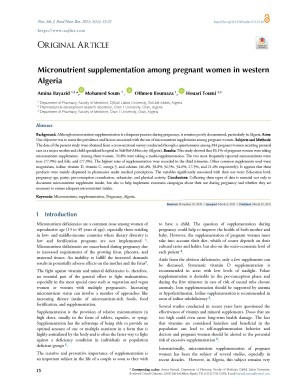
Background: Although micronutrient supplementation is a frequent practice during pregnancy, it remains poorly documented, particularly in Algeria. Aims: Our objective was to assess the prevalence and factors associated with the use of micronutrient supplements among pregnant women. Subjects and Methods: The data of the present study were obtained from a cross-sectional survey conducted through a questionnaire among 384 pregnant women receiving prenatal care at a major mother and child specialized hospital in Sidi-Bel-Abbes city (Algeria). Results: This study showed that 83.1% of pregnant women were taking micronutrient supplements. Among these women, 70,8% were taking a multi-supplementation. The two most frequently reported micronutrients were: iron (77.9%) and folic acid (77.3%). The highest rates of supplementation were recorded in the third trimester. Other common supplements used were: magnesium, iodine, vitamin D, vitamin C, omega 3, and calcium (46.4%, 38.8% 36.5%, 34.6%, 27.3%, and 21.4% respectively). It appears that these products were mainly dispensed in pharmacies under medical prescription. The variables significantly associated with their use were: Education level, pregnancy age, parity, pre-conception consultation, urbanicity, and physical activity. Conclusions: Collecting these types of data is essential not only to document micronutrient supplement intake, but also to help implement awareness campaigns about their use during pregnancy and whether they are necessary to ensure adequate micronutrient intake.
Keywords
How to Cite
Similar Articles
- Supplementation species effect on the phenolic content and biological bioactivities of the decocted green tea
- Efficacy of Moringa Soy Milk as a Food-Based Intervention on Hemoglobin Levels in Anemic Pregnant Women: A Quasi-Experimental Study in Gorontalo, Indonesia
- Dietary patterns and nutrient intake of pregnant women in Afijio and Oyo East Local Government areas of Oyo State, Nigeria
- Contribution of Academic End-of-Studies Projects to the Startup Initiative Adopted by the Ministry of Higher Education and Scientific Research: The Case of the Valorization of Agri-Food Industry By-Products in Algeria
- Talbina as a functional food and a source of health-beneficial ingredients: a narrative review
- Sleep quality and its relationship with climacteric symptoms and quality of life in women on menopausal transition
- Nutrition and food security in Mali from 2010 to 2020
- Cross‐sectional association between lifestyle behavior and cardiometabolic biomarkers in west Algerian postmenopausal women
- Bioactive compounds and antioxidant potential of soft wheat and oat bran on the Algerian market
- Update of the nutritional situation in the Republic of the Sudan
You may also start an advanced similarity search for this article.

 NAJFNR is licensed under