Effect of virgin olive and Pistacia lentiscus oils fortified with tomato lycopene on biochemical parameters in Wistar rats
Copyright © 2021 Authors

This work is licensed under a Creative Commons Attribution 4.0 International License.
- Attribution — You must give appropriate credit, provide a link to the license, and indicate if changes were made.
- No additional restrictions — You may not apply legal terms or technological measures that legally restrict others from doing anything the license permits.





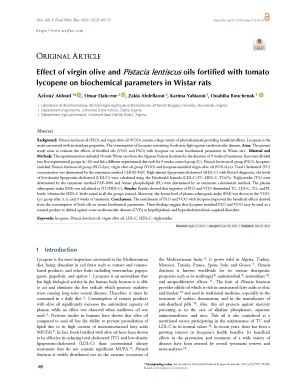
Background: Pistacia lentiscus oil (PLO) and virgin olive oil (VOO) contain a large variety of phytochemicals providing beneficial effects. Lycopene is the main carotenoid with antioxidant properties. The consumption of lycopene containing foods may fight against cardiovascular diseases. Aims: The present study aims to evaluate the effects of fortified oils (VOO and PLO) with lycopene on some biochemical parameters in Wistar rats. Material and Methods: The experimentation included 50 male Wistar rats from the Algerian Pasteur Institute for the duration of 9 weeks of treatment. Rats were divided into five experimental groups (n=10) and fed a different experimental diet each for 9 weeks: control group (C), Pistacia lentiscus oil group (PLO), lycopene-enriched Pistacia lentiscus oil group (PLO-Lyc), virgin olive oil group (VOO) and lycopene-enriched virgin olive oil (VOO-Lyc). Total Cholesterol (TC) concentration was determined by the enzymatic method CHOD-PAP, High-density lipoprotein-cholesterol (HDL-C) with Biotrol diagnostic, the levels of low-density lipoprotein-cholesterol (LDL-C) were calculated using the Friedewald formula (LDL-C=TC−HDL-C−TGs/5). Triglycerides (TG) were determined by the enzymatic method PAP-1000 and Serum phospholipids (PL) were determined by an enzymatic colorimetric method. The plasma atherogenic index (PAI) was calculated as (TC/HDL-C). Results: Results showed that ingestion of PLO and VOO diminished TC, LDL-C, TG, and PL levels, whereas the HDL-C levels raised in all the groups assayed. Moreover, the lowest level of plasma atherogenic index (PAI) was shown in the VOO-Lyc group after 3, 6, and 9 weeks of treatment. Conclusions: The enrichment of PLO and VOO with lycopene improved the beneficial effects derived from the consumption of both oils on serum biochemical parameters. These findings suggest that lycopene enriched PLO and VOO may be used as a natural product to defend against some cardiovascular diseases (CVD) as hyperlipidemic and hypercholesterolemic acquired disorders.
Keywords
How to Cite
Similar Articles
- Effect of Sunlight Exposure and Packaging Materials on the Quality and Oxidative Stability of Commercial Vegetable Oils in Cameroon
- Impact of incorporating sesame oil (Sesamum indicum L.) in an Algerian frying oil and margarine formulation
- Physicochemical characterization and antioxidant capacity of the extracted oil from date pits and its effect on storage stability of margarine
- Impact of deep-fat frying cycles on the physicochemical characteristics of two edible vegetable oils marketed in Algeria
- Effect of peanut-skin fortification on oil separation and consumer acceptance of sesame butter
- Comparative study of total phenolic content and antioxidant proprieties of Quercus fruit: flour and oil
- Amino acid profile and scores of some selected traditional diets commonly consumed in northwest zone, Nigeria
- In vitro antifungal activity of aqueous extract and essential oil of African basil (Ocimum gratissimum L.)
- Association between carotenoids and prostate cancer risk: A meta-analysis
- Antioxidant activity and polyphenol composition of Pistacia terebinthus fruit from Tessala (Western Algeria)
You may also start an advanced similarity search for this article.

 NAJFNR is licensed under