Farm-to-school nutrition programs with special reference to Egypt and Morocco
Copyright © 2021 Tammy Hanel, Brenna Miller, Basil Aboul-Enein, Nada Benajiba, Joanna Kruk

This work is licensed under a Creative Commons Attribution 4.0 International License.
- Attribution — You must give appropriate credit, provide a link to the license, and indicate if changes were made.
- No additional restrictions — You may not apply legal terms or technological measures that legally restrict others from doing anything the license permits.





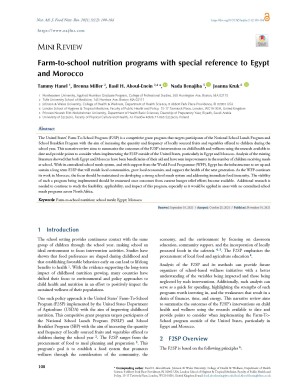
The United States’ Farm-To-School Program (F2SP) is a competitive grant program that targets participants of the National School Lunch Program and School Breakfast Program with the aim of increasing the quantity and frequency of locally sourced fruits and vegetables offered to children during the school year. This narrative review aims to summarize the outcomes of the F2SP’s interventions on child health and wellness using the research available to date and provide points to consider when implementing the F2SP outside of the United States, particularly in Egypt and Morocco. Analysis of the existing literature showed that both Egypt and Morocco have been beneficiaries of their aid and have seen improvements in the number of children receiving meals at school. With its centralized school meals system, and with support from the World Food Programme (WFP), Egypt has the infrastructure to set up and sustain a long term F2SP that will enrich local communities, grow local economies, and support the health of the next generation. As the WFP continues its work in Morocco, the focus should be maintained on developing a strong school meals system and addressing immediate food insecurity. The viability of such a program being implemented should be reassessed once outcomes from current hunger relief efforts become available. Additional research is needed to continue to study the feasibility, applicability, and impact of this program, especially as it would be applied in areas with no centralized school meals programs across North Africa.
Keywords
How to Cite
Similar Articles
- An Observational Study on the Use of Manual Muscle Testing for Dietary Elimination in Food Sensitivity-Related Conditions
- Effect of Citric Acid and Brine Pre-Treatment on Deodorization of Green Banana Flour
- Association of obesity with the lower limbs osteoarthritis in a community of women from El Jadida province in Morocco
- Prevalence of anemia, hematocrit variations, and micronutrient supplementation practices among pregnant women attending antenatal clinics in Ibadan, Southwest Nigeria
- Association between dietary diversity and nutritional status of children aged 6-59 months in the Tamale Metropolis
- The Impact of Black Chokeberry (Aronia melanocarpa) on Gut Microbiota and Human Health: Systematic Review and Meta-analysis of Randomized Controlled Trials in Humans
- Sex and income level can be determinants for meat attachment behavior among Turkish university students
- Effect of a millet-based fortified complementary food on the anthropometric and biochemical indices of anemic infants (6-24 months) - ARTICLE RETRACTED
- Concordance of caregivers and nutritionist MUAC measurements for acute malnutrition screening among children in rural Zimbabwe: A comparative study of the FL-MUAC Approach
- Dietary patterns and nutrient intake of pregnant women in Afijio and Oyo East Local Government areas of Oyo State, Nigeria
You may also start an advanced similarity search for this article.
Most read articles by the same author(s)
- The role of nutrition in strengthening immune system against newly emerging viral diseases: case of SARS-CoV-2
- Association between breakfast intake and short-term memory, performance and mood among Saudi female adolescents
- Comparison of lifestyle patterns and body weight management practices between normal weight and obese female university students (Riyadh – Saudi Arabia)
- Editorial from the new Editor-in-Chief and the new Executive Deputy Editors-in-Chief

 NAJFNR is licensed under