Predictive equations overestimated the rest energy expenditure by indirect calorimetry in adults with sickle cell disease
Copyright © 2022 Karen Cordovil, Marise Crivelli, Larissa Calixto Lima, Flavia S. Barbosa, Marcos Fleury

This work is licensed under a Creative Commons Attribution 4.0 International License.
- Attribution — You must give appropriate credit, provide a link to the license, and indicate if changes were made.
- No additional restrictions — You may not apply legal terms or technological measures that legally restrict others from doing anything the license permits.





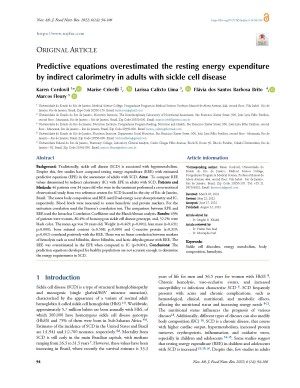
Background: Traditionally, hypermetabolism is described in sickle cell disease (SCD). Despite this, few studies have compared rest energy expenditure (REE) with estimated by predictive equations (EEE) in the assessment of adults with SCD. Aims: To compare REE values determined by indirect calorimetry (IC) with that EEE in adults with SCD. Subjects and Methods: A cross-sectional observational study was performed with 46 individuals over 34 years old in the treatment from two reference centers for SCD located in the city of Rio de Janeiro, Brazil. The dual-energy X-ray absorptiometry (DXA) and IC were used to assess BC and REE, respectively. Blood levels were measured to assess hemolytic and protein markers. Pearson’s correlation test was used in the univariate correlation. The Intraclass Correlation Coefficient (ICC) and the Bland-Altman analysis were used in the comparison between EEE and IC. P-values ≤ 0.05 were considered statistically significant. Results: Most participants were from the female sex, Hb SS genotype (80.4%) and with black color (52.2%). The mean age was 50 years old. Weight (r= 0.469; p=0,001), LM (r = 0.631; p=0.000), BMC (r = 0.508; p=0.000) and CRP(r=0.319; p = 0.002) correlated positively with the REE. There was no linear correlation between makers of hemolysis with REE. The REE was overestimated in the EEE when compared to IC (p<0.001). Conclusions: The prediction equations developed for healthy populations are not accurate enough to determine the energy requirements and more studies are needed to better understand how REE role in middle-aged and elderly adults with SCD.
Keywords
How to Cite
Similar Articles
- Calcium status in Moroccan children and adolescents assessed by 24-hour urinary excretion
- The role of nutrition in strengthening immune system against newly emerging viral diseases: case of SARS-CoV-2
- Nutrition situation of Burkina Faso: a narrative review
- Overview on cardiometabolic associated factors in COVID-19 patients: a narrative review
- Mold Chitosan production using Ficus microcarpa fruit
- Ziziphus lotus (L.) Lam. plant treatment by ultrasounds and microwaves to improve antioxidants yield and quality: An overview
- Visualization of nutrient-related clinical practice guidelines in childhood
- Amino acid profile and scores of some selected traditional diets commonly consumed in northwest zone, Nigeria
- Prevalence of prediabetes in an urban Nigerian population using the Finnish Diabetes Risk Score.
- Nutritional status among pregnant adolescents at maternity teaching hospital
You may also start an advanced similarity search for this article.

 NAJFNR is licensed under