Quality of life, perceived stress and nutrition of patients with irritable bowel syndrome: A descriptive study
Copyright © 2022 Zehra Margot Çelik, Şule Aktaç, Güleren Sabuncular, Tuğçe Dirican, Aleyna Habibe Demir

This work is licensed under a Creative Commons Attribution 4.0 International License.
- Attribution — You must give appropriate credit, provide a link to the license, and indicate if changes were made.
- No additional restrictions — You may not apply legal terms or technological measures that legally restrict others from doing anything the license permits.





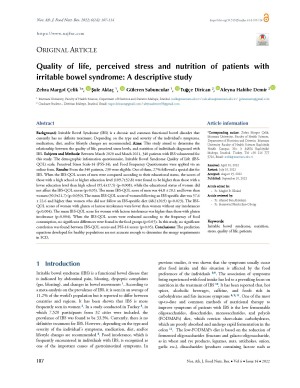
Background: Irritable Bowel Syndrome (IBS) is a chronic and common functional bowel disorder that currently has no definite treatment. Depending on the type and severity of the individual's symptoms, medication, diet, and/or lifestyle changes are recommended. Aims: This study aimed to determine the relationship between the quality of life, perceived stress levels, and nutrition of individuals diagnosed with IBS. Subjects and Methods: Between March 2020 and March 2021, 340 patients with IBS volunteered for this study. The demographic information questionnaire, Irritable Bowel Syndrome Quality of Life (IBS-QOL) scale, Perceived Stress Scale-14 (PSS-14), and Food Frequency Questionnaire were applied via an online form. Results: From the 340 patients, 230 were eligible. Out of them, 27% followed a special diet for IBS. When the IBS-QOL scores of men were compared according to their educational status, the scores of those with a high school or higher education level (109.7±32.8) were found to be higher than those with a lower education level than high school (95.4±17.5) (p=0.008), while the educational status of women did not affect the IBS-QOL scores (p>0.05). The mean IBS-QOL score of men was 44.8 ± 20.1 and lower than women (50.9±21.7) (p=0.030). The mean IBS-QOL score of women following an IBS-specific diet was 57.6 ± 22.6 and higher than women who did not follow an IBS-specific diet (48.2±20.9) (p=0.023). The IBS-QOL scores of women with gluten or lactose intolerance were lower than women without any intolerances (p=0.004). The mean IBS-QOL score for women with lactose intolerance was higher than those with gluten intolerance (p=0.004). When the IBS-QOL scores were evaluated according to the frequency of food consumption, no significant differences were found in the food groups (p>0.05). In this study, no significant correlation was found between IBS-QOL scores and PSS-14 scores (p>0.05). Conclusions: The prediction equations developed for healthy populations are not accurate enough to determine the energy requirements in SCD.
Keywords
How to Cite
Similar Articles
- Evaluation of Technological Performance of Algerian Soft Wheat Varieties
- Traditional Tunisian Pasta "Nwasser" Enriched with Wheat Bran: Impact on Physicochemical Quality, Nutritional Profile, and Acute Post-Prandial Glycemic Response in Healthy Individuals
- Nutrient composition of leaves and seeds in selected African Indigenous Vegetables (AIVs): Potential for addressing malnutrition in children under five in Sub-Saharan Africa
- Nutrition in contemporary Zimbabwe: a situational analysis
- Update of the Nutrition Situation in Nigeria
- Mediterranean diet and food consumption in an urban adult population of Northwest Algeria
- Adherence to the Mediterranean Diet and anthropometric profile of obese Algerian subjects
- Use and influence of food and nutrition security vulnerability assessment and analysis reports in Zimbabwe
- Influence of Grain Size on the Agglomeration and Quality of Fine Couscous Derived from Decorticated White Sorghum Bicolor L.
- Visualization of nutrient-related clinical practice guidelines in childhood
You may also start an advanced similarity search for this article.
Most read articles by the same author(s)
- Exploring the interplay between social media addiction, mindful eating, intuitive eating, orthorexia nervosa, and mental health in young adults
- Differences in dietary intake between Turkish vegans and omnivores: a cross-sectional study
- Examination of traditional fermented food consumption and product awareness of university students in Istanbul, Turkey
- Investigation of total aflatoxin in nuts and dried fruits and consumption habits during pregnancy in Türkiye

 NAJFNR is licensed under