The relationship between nutrition screenings and nutritional status determined by malnutrition in hemodialysis patients
Copyright © 2022 Tugce Yilmaz, Gozde Aritici Colak

This work is licensed under a Creative Commons Attribution 4.0 International License.
- Attribution — You must give appropriate credit, provide a link to the license, and indicate if changes were made.
- No additional restrictions — You may not apply legal terms or technological measures that legally restrict others from doing anything the license permits.





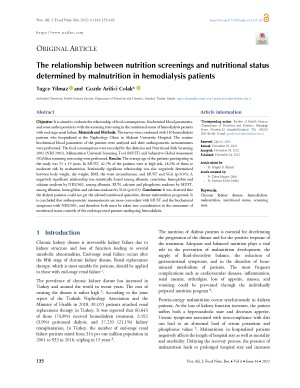
Objective: It is aimed to evaluate the relationship of food consumptions, biochemical blood parameters, and some anthropometrics with the screening tests using in the nutritional status of hemodialysis patients with end stage renal failure. Materials and Methods: The survey were conducted with 110 hemodialysis patients who hospitalized at the Nephrology Clinic in Akdeniz University Hospital. The routine biochemical blood parameters of the patients were analyzed and their anthropometric measurements were performed. The food consumptions were recorded by the dietician and Nutritional Risk Screening 2002 (NRS 2002), Malnutrition Universal Screening Tool (MUST) and Subjective Global Assessment (SGA)has screening tests using were performed. Results: The average age of the patients participating in the study was 55 ± 19 years. In MUST, 42.7% of the patients were at high risk, 18.2% of them at moderate risk by malnutrition. Statistically significant relationship was also negatively determined between body weight, dry weight, BMI, the waist circumference, and MUST and SGA (p<0.05). A negatively significant relationship was statistically found among albumin, creatinine, hemoglobin and calcium readouts by NRS2002, among albumin, BUN, calcium and phosphorus readouts by MUST, among albumin, hemoglobin and calcium readouts by SGA (p<0.05). Conclusion: It was observed that the dialysis patients could not get the advised nutritional quantities, thence malnutrition progressed. It is concluded that anthropometric measurements are more concordant with MUST and the biochemical symptoms with NRS2002, and therefore both must be taken into consideration in the assessment of nutritional status correctly of the end-stage renal patients undergoing hemodialysis.
Keywords
How to Cite
Similar Articles
- Quantitative and qualitative assessment of food waste in rural markets in Morocco
- Effects of traditional processing techniques on nutritional quality and sensory acceptability of value-added products made from cowpea (Vigna unguiculata L. walp.) produced in Ethiopia
- Comparative Nutritional Characterization of a Novel Formulated Composite Milk Alternative and a Conventional Infant Formula : (Corrected Proof)
- Effects of complementary food formulated from millet, soybean, and grasshopper on hematological parameters of malnourished weanling albino rats
- Physicochemical characteristics and nutritional value of safflower oil: A potential sustainable crop for Egypt
- Enhancing Freshwater Fish Consumption in Algeria: A Study on the Nutritional and Sensory Attributes of Common Carp Sticks
- Prevalence of Peptic Ulcer Disease and Dietary Pattern among Students of a Private University in Nigeria
- Advantages and Drawbacks of Plant-Based Beverages as Alternatives to Animal Milk: A Multidimensional Review
- Sprouting bioprocess as a sustainable tool for enhancing durum wheat (Triticum durum) nutrients and bioactive compounds
- Enhancing food and nutritional security through Gender-Disaggregated Analysis: A case study of Lake Victoria Shore, Tanzania
You may also start an advanced similarity search for this article.

 NAJFNR is licensed under