Metabolic syndrome components correlation with colorectal neoplasms: A systematic review and a meta-analysis
Copyright © 2018 Authors

This work is licensed under a Creative Commons Attribution 4.0 International License.
- Attribution — You must give appropriate credit, provide a link to the license, and indicate if changes were made.
- No additional restrictions — You may not apply legal terms or technological measures that legally restrict others from doing anything the license permits.





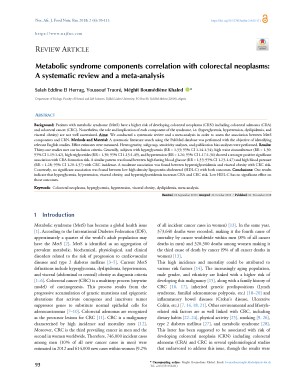
Background: Patients with metabolic syndrome (MetS) have a higher risk of developing colorectal neoplasms (CRN) including colorectal adenoma (CRA) and colorectal cancer (CRC). Nonetheless, the role and implication of each component of the syndrome, i.e. (hyperglycemia, hypertension, dyslipidemia, and visceral obesity) are not well ascertained. Aims: We conducted a systematic review and a meta-analysis in order to assess the association between MetS components and CRN. Methods and Material: A systematic literature search using the PubMed database was performed with the objective of identifying relevant English studies. Effect estimates were measured. Heterogeneity, subgroup, sensitivity analyses, and publication bias analyses were performed. Results: Thirty-one studies met our inclusion criteria. Generally, subjects with hyperglycemia (RR = 1.33; 95% CI 1.14-1.54), high waist circumference (RR = 1.30; 95% CI 1.19-1.42), high triglycerides (RR = 1.30; 95% CI 1.13-1.49), and hypertension (RR = 1.26; 95% CI 1.17-1.36) showed a stronger positive significant association with CRA formation risk. A similar pattern was found between high fasting blood glucose (RR = 1.35; 95% CI 1.23-1.47) and high blood pressure (RR = 1.28; 95% CI 1.20-1.37) with CRC incidence. A moderate association was found between hypertriglyceridemia and visceral obesity with CRC risk. Conversely, no significant association was found between low high-density lipoprotein-cholesterol (HDL-C) with both outcomes. Conclusions: Our results indicate that hyperglycemia, hypertension, visceral obesity, and hypertriglyceridemia increases CRA and CRC risk. Low HDL-C has no significant effect on those outcomes.
Keywords
How to Cite
Similar Articles
- Statistical study of the relationship between hyperuricemia, dyslipidemia and type 2 diabetes in rural population of Tizi-Ouzou, Algeria
- Ameliorative Effects of Citrus aurantium Juice on Metabolic Disorders Induced by Trans Fatty Acid-Rich Amalgam in Wistar rats
- Anticarcinogenic and antioxidant activities of leaves and flowers hydroalcoholic extracts of Nerium oleander L.: PCA analysis and phytochemical content by FTIR spectroscopy
- Nutritional Status and Beverage Intake Patterns among Civil Servants in Southwestern Nigeria
- Nutrition situation of Burkina Faso: a narrative review
- Effects of the Withania somnifera supplementation on sports performance: a systematic review and meta-analysis
- Determination of nutrient composition of some selected traditional home- made meals commonly consumed in Syria
- Diet, weight status, and physical activity in cancer prevention
- Comparison of lifestyle patterns and body weight management practices between normal weight and obese female university students (Riyadh – Saudi Arabia)
- Visualization of nutrient-related clinical practice guidelines in childhood
You may also start an advanced similarity search for this article.
Most read articles by the same author(s)
- Epidemiology, diagnosis, and assessment of diabetes mellitus in the elderly population: a purposive review
- The role of nutrition in strengthening immune system against newly emerging viral diseases: case of SARS-CoV-2
- Predatory journals and publishers at a glance: Take apart or take over?
- Overview on main nutrition-related diseases in three countries from North Africa
- Understanding Bread Consumption and Waste Patterns in Algeria and Tunisia: Insights into Consumer Practices and Challenges
- Physicochemical quality assessment of Brazilian frozen beef imported into Algeria
- Metabolic syndrome and risk of colorectal adenoma and colorectal cancer: A meta-analysis
- New insight on nutrition and COVID-19 pandemic
- Editorial introduction to the first issue
- Association between carotenoids and prostate cancer risk: A meta-analysis

 NAJFNR is licensed under