Nutrition Education Intervention on maternal knowledge, and perception toward infant and young child feeding in Abakaliki Metropolis, Nigeria
Copyright © 2023 Linda Obianuju Edafioghor, Chinonyelum Thecla Ezeonu, Uzoma Vivian Asiegbu, Gideon Onyedikachi Iheme

This work is licensed under a Creative Commons Attribution 4.0 International License.
- Attribution — You must give appropriate credit, provide a link to the license, and indicate if changes were made.
- No additional restrictions — You may not apply legal terms or technological measures that legally restrict others from doing anything the license permits.





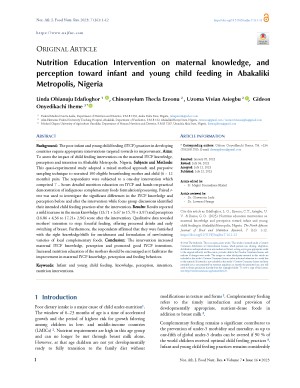
Background: The poor infant and young child feeding (IYCF) practices in developing countries require appropriate interventions targeted towards its improvement. Aims: To assess the impact of child feeding intervention on the maternal IYCF knowledge, perception and intention in Abakaliki Metropolis, Nigeria. Subjects and Methods: This quasi-experimental study adopted a mixed method approach and purposive sampling technique to recruited 100 eligible breastfeeding mother and child (6 – 12 months) pairs. The respondents were subjected to a one-day intervention which comprised 7 – hours detailed nutrition education on IYCF and hands-on-practical demonstration of indigenous complementary foods formulation/processing. Paired t-test was used to investigate the significant differences in the IYCF knowledge and perception before and after the intervention while focus group discussions identified their intended child feeding practices after the intervention. Results: Results reported a mild increase in the mean knowledge (13.71 + 3.67 to 15.79 + 3.97) and perception (16.86 + 4.36 to 17.21+ 2.96) score after the intervention. Qualitative data revealed mothers’ intention to stop; forceful feeding, offering processed drinks and early switching of breast. Furthermore, the respondents affirmed that they were furnished with the right knowledge/skills for enrichment and formulation of new/existing varieties of local complementary foods. Conclusion: The intervention increased maternal IYCF knowledge, perception and promoted good IYCF intentions. Increased nutrition education of the mothers should be encouraged as it facilitates the improvement in maternal IYCF knowledge, perception and feeding behaviors.
Keywords
How to Cite
References
Black, R.E., Victora, C.G., Walker,S.P.,Bhutta, Z.A., Christian, P., De Onis, M., Ezzati, M., Grantham-McGregor, S., Katz, J., Martorell, R., et al. (2013). Maternal and Child Nutrition Study Group. Maternal and child undernutrition and overweight in low-income and middle-income countries. Lancet, 382, 427– 51. https://doi.org/10.1016/s0140-6736(13)60937-x
Panjwani, A., & Heidkamp, R. (2017). Complementary Feeding Interventions have a small but Significant Impact on Linear and Ponderal Growth of Children in Low- and Middle-Income Countries: A Systematic Review and Meta-Analysis. The Journal of Nutrition, 147, 2169-2178 https://doi.org/10.3945/jn.116.243857
World Health Organization (1998). Programme of Nutrition. Complementary feeding of young children in developing countries: a review of current scientific knowledge. 1998. Retrieved from https://apps.who.int/iris/handle/10665/65932
National Population Commission (NPC) [Nigeria] and ICF (2019). Nigeria Demographic and Health Survey 2018 Key Indicators Report. Abuja, Nigeria, and Rockville, Maryland, USA: NPC and ICF.
Arikpo, D., Edet, E.S., Chibuzor, M.T., Odey, F., & Caldwell, D.M. (2018). Educational interventions for improving primary caregiver complementary feeding practices for children aged 24 months and under. Cochrane Database of Systematic Reviews, 18 (5), CD011768. https://doi.org/10.1002%2F14651858.CD011768.pub2
Krebs, N.F., Hambidge, K.M., Mazariegos, M., Westcott, J., Goco, N., & Wright, LL. (2011). Complementary feeding: a global network cluster randomized controlled trial. BMC Pediatrics, 11(4), 4. https://doi.org/10.1186/1471-2431-11-4
Dewey, K.G. &Adu-Afarwuah, S. (2008). Systematic review of the efficacy and effectiveness of complementary feeding interventions in developing countries. Maternal and Child Nutrition, 4, 24-85. https://doi.org/10.1111/j.1740-8709.2007.00124.x
Plessis, L.M., Kruger, H.S., & Sweet, L. (2013) Complementary feeding: a critical window of opportunity from six months onwards. South African Journal of Clinical Nutrition, 26, 129–140.
Onoja, U.S., & Obizoba, I.C. (2009). Nutrient composition and organoleptic attributes of gruel based on fermented cereal, legume, tuber and root flour. Agro-Science Journal of Tropical Agriculture, Food, Environment and Extension. 8, 162-168.
Similar Articles
- Prevalence of Peptic Ulcer Disease and Dietary Pattern among Students of a Private University in Nigeria
- Evaluation of Nutritional Status Among COVID-19 Patients Admitted to the Intensive Care Unit in Jeddah, Saudi Arabia: A Cross-Sectional Observational Study
- Nutrition situation of Burkina Faso: a narrative review
- The Impact of Black Chokeberry (Aronia melanocarpa) on Gut Microbiota and Human Health: Systematic Review and Meta-analysis of Randomized Controlled Trials in Humans
- Prevalence and determinants of overweight and obesity among in-school adolescents in Harare, Zimbabwe
- Nutritional status of school-age children and adolescents in eastern and southern Africa: A scoping review
- Consumption patterns of sugar-sweetened beverages among tertiary institution students in Abeokuta, Nigeria and their association with the risk of developing type 2 diabetes using FINDRISC
- Anthropometric, dietary, and nutritional outcomes of vegetarian and vegan diets in childhood: A narrative review and recommendations for adequate nutrition
- Understanding Bread Consumption and Waste Patterns in Algeria and Tunisia: Insights into Consumer Practices and Challenges
- Prevalence of anemia, hematocrit variations, and micronutrient supplementation practices among pregnant women attending antenatal clinics in Ibadan, Southwest Nigeria
You may also start an advanced similarity search for this article.

 NAJFNR is licensed under