Calcium status in Moroccan children and adolescents assessed by 24-hour urinary excretion
Copyright © 2019 Authors

This work is licensed under a Creative Commons Attribution 4.0 International License.
- Attribution — You must give appropriate credit, provide a link to the license, and indicate if changes were made.
- No additional restrictions — You may not apply legal terms or technological measures that legally restrict others from doing anything the license permits.





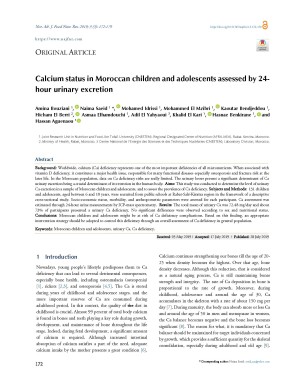
Background: Worldwide, calcium (Ca) deficiency represents one of the most important deficiencies of all micronutrients. When associated with vitamin D deficiency, it constitutes a major health issue, responsible for many functional diseases especially osteoporosis and fracture risk at the later life. In the Moroccan population, data on Ca deficiency risks are really limited. The urinary losses present a significant determinant of Ca urinary excretion being a crucial determinant of its retention in the human body. Aims: This study was conducted to determine the level of urinary Ca excretion in a sample of Moroccan children and adolescents, and to assess the prevalence of Ca deficiency. Methods and Material: 131 children and adolescents, aged between 6 and 18 years, were recruited from public schools at Rabat-Salé-Kénitra region in the framework of a descriptive cross-sectional study. Socio-economic status, morbidity, and anthropometric parameters were assessed for each participant. Ca assessment was estimated through 24-hour urine measurements by ICP-mass spectrometry. Results: The total mean of urinary Ca was 72.48 mg/day and about 73% of participants presented a urinary Ca deficiency. No significant differences were observed according to sex and nutritional status. Conclusions: Moroccan children and adolescents might be at risk of Ca deficiency complications. Based on this finding, an appropriate intervention strategy should be adopted to control this deficiency through an overall assessment of Ca deficiency in general population.
Keywords
How to Cite
Similar Articles
- Pica in sickle cell disease: nutritional management and implications
- Association between dietary diversity and nutritional status of children aged 6-59 months in the Tamale Metropolis
- Study of the relationship between nutrition, physical activity and overweight/obesity in children in a school context: Study of the relationship between nutrition, physical activity
- Prevalence and trend of malaria with anemia among under-five children in Jasikan District, Ghana
- Relationship between intake of energy-dense diets and nutritional status of adolescents in primary schools in Nairobi City County, Kenya
- Nutrient composition of leaves and seeds in selected African Indigenous Vegetables (AIVs): Potential for addressing malnutrition in children under five in Sub-Saharan Africa
- Effect of a millet-based fortified complementary food on the anthropometric and biochemical indices of anemic infants (6-24 months) - ARTICLE RETRACTED
- Risk factors associated with Severe Acute Malnutrition (SAM) in children aged 6 – 59 months in the Mokolo Health District, Far North region of Cameroon: Risk factors associated with Severe Acute Malnutrition in 6-59 months children
- Determinants of overweight and obesity among adolescents in Zimbabwe: A scoping review
- Participatory cooking demonstrations for mothers improve feeding practices of young children in southern Benin
You may also start an advanced similarity search for this article.
Most read articles by the same author(s)
- Acceptance of salt reduction in bakery bread among Moroccan consumers
- Diet, weight status, and physical activity in cancer prevention
- Hypertension in Moroccan adults: sociodemographic, lifestyle, and dietary risk factors
- Association of socioeconomic status, dietary behavior and obesity among Moroccan adults of the region of Rabat: A case-control study

 NAJFNR is licensed under