Acceptance of salt reduction in bakery bread among Moroccan consumers
Copyright © 2020 Authors

This work is licensed under a Creative Commons Attribution 4.0 International License.
- Attribution — You must give appropriate credit, provide a link to the license, and indicate if changes were made.
- No additional restrictions — You may not apply legal terms or technological measures that legally restrict others from doing anything the license permits.





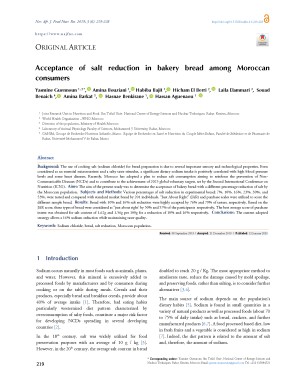
Background: The use of cooking salt (sodium chloride) for bread preparation is due to several essential sensory and technological properties. Even considered as an essential micronutrient and a salty taste stimulus, a significant dietary sodium intake is positively correlated with high blood pressure levels and some heart diseases. Recently, Morocco has adopted a plan to reduce salt consumption aiming to reinforce the prevention of Non-Communicable Diseases (NCDs) and to contribute to the achievement of 2025 global voluntary targets, set by the Second International Conference on Nutrition (ICN2). Aims: The aim of the present study was to determine the acceptance of bakery bread with a different percentage reduction of salt by the Moroccan population. Subjects an Methods: Various percentages of salt reduction in experimental bread; 7%, 10%, 16%, 23%, 30%, and 53%, were tasted and compared with standard market bread by 201 individuals. “Just About Right” (JAR) and purchase scales were used to score the different bread. Results: Bread with 10% and 16% salt reduction were highly accepted by 76% and 79% of tasters, respectively. Based on the JAR score, these types of bread were considered as “just about right’ by 50% and 57% respectively by the participants. The best average score of purchase intent was obtained for salt content of 1.62g and 1.56g per 100g for a reduction of 10% and 16% respectively. Conclusions: The current adopted strategy allows a 16% sodium reduction while maintaining taste quality.
Keywords
How to Cite
Similar Articles
- Understanding Bread Consumption and Waste Patterns in Algeria and Tunisia: Insights into Consumer Practices and Challenges
- Association between 24-hour urinary sodium and iodine in a Beninese population
- Calcium status in Moroccan children and adolescents assessed by 24-hour urinary excretion
- Mediterranean diet and food consumption in an urban adult population of Northwest Algeria
- Hypertension in Moroccan adults: sociodemographic, lifestyle, and dietary risk factors
- Association of socioeconomic status, dietary behavior and obesity among Moroccan adults of the region of Rabat: A case-control study
- Translation, Cultural Adaptation, and Validation of the Arabic Version of the STRONGkids Nutrition Screening Tool in the Moroccan Pediatric Clinical Setting
- Effects of extrusion on nutritional and non-nutritional properties in the production of multigrain ready to eat snacks incorporated with NUA45 beans
- Association of obesity with the lower limbs osteoarthritis in a community of women from El Jadida province in Morocco
- An overview on the nutrition transition and its health implications: Tunisia case
You may also start an advanced similarity search for this article.
Most read articles by the same author(s)
- Diet, weight status, and physical activity in cancer prevention
- Hypertension in Moroccan adults: sociodemographic, lifestyle, and dietary risk factors
- Association of socioeconomic status, dietary behavior and obesity among Moroccan adults of the region of Rabat: A case-control study
- Calcium status in Moroccan children and adolescents assessed by 24-hour urinary excretion
- Nutritional Status, Muscle Mass, and Body Fat Percentage in Patients with Breast Cancer Undergoing Adjuvant Chemotherapy

 NAJFNR is licensed under