Rapid survey on lifestyle changes and body weight gain among Algerians during COVID-19 lockdown
Copyright © 2020 Authors

This work is licensed under a Creative Commons Attribution 4.0 International License.
- Attribution — You must give appropriate credit, provide a link to the license, and indicate if changes were made.
- No additional restrictions — You may not apply legal terms or technological measures that legally restrict others from doing anything the license permits.





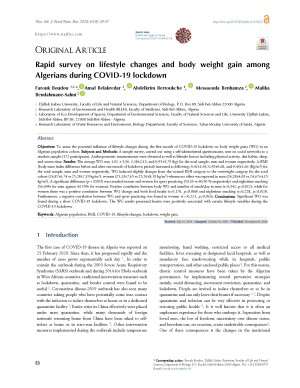
Objectives: To assess the potential influence of lifestyle changes during the first month of COVID-19 lockdown on body weight gains (WG) in an Algerian population cohort. Subjects and Methods: A sample survey, carried out using a self-administered questionnaire, sent on social networks to a random sample (172 participants). Anthropometric measurements were obtained as well as lifestyle factors including physical activity, diet habits, sleep, and screen time. Results: The average WG was; 1.02 ± 3.36, 1.18±2.15, and 0.95±3.79 (kg) for the total sample, men and women respectively. Δ-BMI (body mass index difference before and after one month of lockdown period) increased as following; 0.42±1.43, 0.39±0.68, and 0.43±1.66 (Kg/m²) for the total sample, men and women respectively. WG induced slightly changes from the normal BMI category to the overweight category for the total cohort (24.87±6.74 vs 25.28±7.19 kg/m²), women (25.13±7.65 vs 25.56±8.19 kg/m²) whereas no effect was reported in men (24.28±4.03 vs 24.67±4.15 kg/m²). A significant difference (p < 0.001) was revealed in men and women for sport practicing (53.33 vs 40.90 % respectively) and nighttime snacking (56.60% for men against 43.55% for women). Positive correlation between body WG and number of meals/day in men (r=0,341, p=0,012), while for women there was a positive correlation between WG change and both food intake (r=0.170, p=0.066) and nighttime snacking (r=0,228, p=0,013). Furthermore, a negative correlation between WG and sport practicing was found in women (r =-0.221, p=0.016). Conclusions: Significant WG was found during a short Covid-19 lockdown. The WG results presented herein were positively associated with certain lifestyle variables during the Covid-19 lockdown.
Keywords
How to Cite
Similar Articles
- Food and Water Security in Developing Economies: Impact of Pandemic and Possible Interventions
- Immune-stimulating and antioxidant properties of a traditional Algerian plant combination: Date fruit (Phoenix dactylifera) and Fenugreek seeds (Trigonella foenum-graecum)
- Quantitative and qualitative assessment of food waste in rural markets in Morocco
- Evaluation of Technological Performance of Algerian Soft Wheat Varieties
- Physical properties and chemical composition of three Ethiopian rice (Oryza sativa Linn.) varieties compared to tef [Eragrostis tef (Zucc.) Trotter] grain
- Bioactive compounds and antioxidant potential of soft wheat and oat bran on the Algerian market
- Statistical study of the relationship between hyperuricemia, dyslipidemia and type 2 diabetes in rural population of Tizi-Ouzou, Algeria
- Nutrition in contemporary Zimbabwe: a situational analysis
- Food profile and its effect on the occurrence of diabetes in patients living with HIV: A cross-sectional study at the Nylon district hospital, Cameroon
- Body composition, energy expenditure, and markers of hemolysis in adults with sickle cell disease
You may also start an advanced similarity search for this article.

 NAJFNR is licensed under