Metabolic syndrome and risk of colorectal adenoma and colorectal cancer: A meta-analysis
Copyright © 2017 Authors

This work is licensed under a Creative Commons Attribution 4.0 International License.
- Attribution — You must give appropriate credit, provide a link to the license, and indicate if changes were made.
- No additional restrictions — You may not apply legal terms or technological measures that legally restrict others from doing anything the license permits.





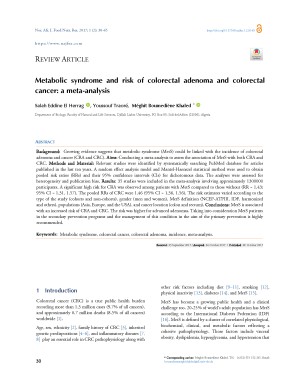
Background: Growing evidence suggests that metabolic syndrome (MetS) could be linked with the incidence of colorectal adenoma and cancer (CRA and CRC). Aim: Conducting a meta-analysis to assess the association of MetS with both CRA and CRC. Methods and Material: Relevant studies were identified by systematically searching PubMed database for articles published in the last ten years. A random effect analysis model and Mantel-Haenszel statistical method were used to obtain pooled risk ratios (RRs) and their 95% confidence intervals (CIs) for dichotomous data. The analyses were assessed for heterogeneity and publication bias. Results: 35 studies were included in the meta-analysis involving approximately 1300000 participants. A significant high risk for CRA was observed among patients with MetS compared to those without (RR = 1.43; 95% CI = 1.31, 1.57). The pooled RRs of CRC were 1.46 (95% CI = 1.36, 1.56). The risk estimates varied according to the type of the study (cohorts and non-cohorts), gender (men and women), MetS definition (NCEP-ATPIII, IDF, harmonized and others), populations (Asia, Europe, and the USA), and cancer location (colon and rectum). Conclusions: MetS is associated with an increased risk of CRA and CRC. The risk was higher for advanced adenomas. Taking into consideration MetS patients in the secondary prevention programs and the management of this condition in the aim of the primary prevention is highly recommended.
Keywords
How to Cite
Similar Articles
- Effect of incorporating Lippia javanica (Zumbani) on physical, nutritional, microbiological, and sensory properties of instant soup mix powder
- Proteome consistency of the aleurone layer in grain of major wheat species grown over different years
- COVID-19 and vitamin D supplementation: Is there any evidence based to reduce the risk?
- Statistical study of the relationship between hyperuricemia, dyslipidemia and type 2 diabetes in rural population of Tizi-Ouzou, Algeria
- The Inhibitory Effect of Selenium Supplementation on Tumor Progression in a DMBA-Induced Breast Cancer Model in Wistar Rats
- Proximate analysis of selected agricultural waste for their nutritional potential
- Determination of isoflavones from soy-milk, masoor and mung dal soups in Bangladeshi postmenopausal women
- Quality of life, perceived stress and nutrition of patients with irritable bowel syndrome: A descriptive study
- Acid-Induced Gelation of European Eel Protein Isolate Fortified with Fish Oil: Enhancement of Physicochemical, Microstructural and Thermal Properties
- Determination of nutrient composition of some selected traditional home- made meals commonly consumed in Syria
You may also start an advanced similarity search for this article.
Most read articles by the same author(s)
- Epidemiology, diagnosis, and assessment of diabetes mellitus in the elderly population: a purposive review
- The role of nutrition in strengthening immune system against newly emerging viral diseases: case of SARS-CoV-2
- Predatory journals and publishers at a glance: Take apart or take over?
- Overview on main nutrition-related diseases in three countries from North Africa
- Understanding Bread Consumption and Waste Patterns in Algeria and Tunisia: Insights into Consumer Practices and Challenges
- Physicochemical quality assessment of Brazilian frozen beef imported into Algeria
- New insight on nutrition and COVID-19 pandemic
- Metabolic syndrome components correlation with colorectal neoplasms: A systematic review and a meta-analysis
- Editorial introduction to the first issue
- Ameliorative Effects of Citrus aurantium Juice on Metabolic Disorders Induced by Trans Fatty Acid-Rich Amalgam in Wistar rats

 NAJFNR is licensed under