Phytochemical analysis, antioxidant and anti-Candida albicans activities of Annona cherimola Mill. fruit pulp
Copyright © 2018 Authors

This work is licensed under a Creative Commons Attribution 4.0 International License.
- Attribution — You must give appropriate credit, provide a link to the license, and indicate if changes were made.
- No additional restrictions — You may not apply legal terms or technological measures that legally restrict others from doing anything the license permits.





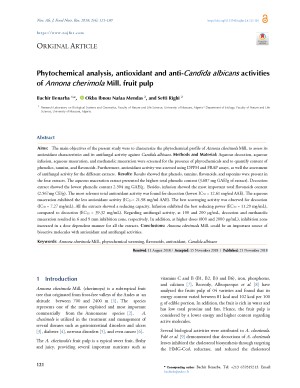
Aims: The main objectives of the present study were to characterize the phytochemical profile of Annona cherimola Mill, to assess its antioxidant characteristics and its antifungal activity against Candida albicans. Methods and Material: Aqueous decoction, aqueous infusion, aqueous maceration, and methanolic maceration were screened for the presence of phytochemicals and to quantify content of phenolics, tannins, and flavonoids. Furthermore, antioxidant activity was assessed using DPPH and FRAP assays, as well the assessment of antifungal activity for the different extracts. Results: Results showed that phenols, tannins, flavonoids, and saponins were present in the four extracts. The aqueous maceration extract presented the highest total phenolic content (3.687 mg GAE/g of extract). Decoction extract showed the lowest phenolic content 2.504 mg GAE/g. Besides, infusion showed the most important total flavonoids content (2.567mg CE/g). The most relevant total antioxidant activity was found for decoction (lowest IC50 12.61 mg/ml AAE). The aqueous maceration exhibited the less antioxidant activity (IC50= 21.98 mg/ml AAE). The best scavenging activity was observed for decoction (IC50=7.27 mg/mL). All the extracts showed a reducing capacity. Infusion exhibited the best reducing power (EC50 = 11.29 mg/mL), compared to decoction (EC50 = 39.32 mg/mL). Regarding antifungal activity, at 100 and 200 µg/mL, decoction and methanolic maceration resulted in 6 and 9 mm inhibition zone, respectively. In addition, at higher doses (800 and 2000 µg/mL), inhibition zone increased in a dose dependent manner for all the extracts. Conclusions: Annona cherimola Mill. could be an important source of bioactive molecules with antioxidant and antifungal activities.
Keywords
How to Cite
Similar Articles
- Quantitative analysis of proanthocyanidins (tannins) from cardinal grape (Vitis vinifera) skin and seed by RP-HPLC
- Sprouting bioprocess as a sustainable tool for enhancing durum wheat (Triticum durum) nutrients and bioactive compounds
- Nutritional properties and plausible benefits of Pearl millet (Pennisetum glaucum) on bone metabolism and osteoimmunology : a mini-review
- Cross‐sectional association between lifestyle behavior and cardiometabolic biomarkers in west Algerian postmenopausal women
- Sodium metabisulfite dipping, hot water blanching and sulfur fumigation impact on the nutritional quality of dried apricot (Prunus armeniaca L.) cultivars
- Effects of extrusion on nutritional and non-nutritional properties in the production of multigrain ready to eat snacks incorporated with NUA45 beans
- Seed from olive cake prevents hyperglycemia, hyperlipidemia, and oxidative stress in dexamethasone-induced diabetes rats
- Dietary behaviors, food accessibility, and handling practices during SARS-CoV-2 pandemic in Benin
- Effect of a millet-based fortified complementary food on the anthropometric and biochemical indices of anemic infants (6-24 months) - ARTICLE RETRACTED
- Farm-to-school nutrition programs with special reference to Egypt and Morocco
You may also start an advanced similarity search for this article.
Most read articles by the same author(s)
- Enhancing food security through scientific research in Algeria. A novel vision and unified national strategy
- New insight on nutrition and COVID-19 pandemic
- The Inhibitory Effect of Selenium Supplementation on Tumor Progression in a DMBA-Induced Breast Cancer Model in Wistar Rats
- Pre-exposure and Post-exposure new prophylactic treatments against COVID-19 in healthcare workers

 NAJFNR is licensed under