Effect of traditional sun-drying and oven-drying on carotenoids and phenolic compounds of apricot (Prunus armeniaca L.)
Copyright © 2019 Authors

This work is licensed under a Creative Commons Attribution 4.0 International License.
- Attribution — You must give appropriate credit, provide a link to the license, and indicate if changes were made.
- No additional restrictions — You may not apply legal terms or technological measures that legally restrict others from doing anything the license permits.





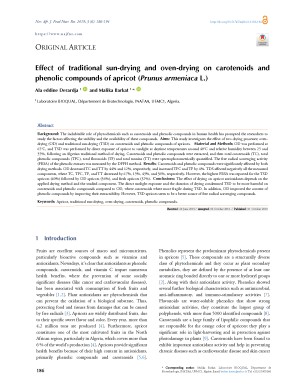
Background: The indubitable role of phytochemicals such as carotenoids and phenolic compounds in human health has prompted the researchers to study the factors affecting the stability and the availability of these compounds. Aims: This study investigates the effect of two drying processes; oven-drying (OD) and traditional sun-drying (TSD) on carotenoids and phenolic compounds of apricots. Methods and Material: OD was performed at 65°C, and TSD was performed by direct exposure of apricot to sunlight at daytime temperatures around 40°C and relative humidity between 25 and 35%, following an Algerian traditional method of drying. Carotenoids and phenolic compounds were extracted, and then total carotenoids (TC), total phenolic compounds (TPC), total flavonoids (TF) and total tannins (TT) were spectrophotometrically quantified. The free radical scavenging activity (FRSA) of the phenolic extracts was measured by the DPPH method. Results: Carotenoids and phenolic compounds were significantly affected by both drying methods. OD decreased TC and TT by 44% and 12%, respectively, and increased TPC and TF by 4%. TDS affected negatively all the measured components, where TC, TPC, TF, and TT decreased by 67%, 15%, 43%, and 36%, respectively. However, the highest FRSA was reported for the TSD apricots (40%) followed by OD apricots (36%), and fresh apricots (32%). Conclusions: The effect of drying on apricot antioxidants depends on the applied drying method and the studied component. The direct sunlight exposure and the duration of drying condemned TSD to be more harmful on carotenoids and phenolic compounds compared to OD, where carotenoids where more fragile during TSD. In addition, OD improved the content of phenolic compounds by improving their extractability. However, TSD apricots seem to be a better source of free radical scavenging compounds.
Keywords
How to Cite
Similar Articles
- Ziziphus lotus (L.) Lam. plant treatment by ultrasounds and microwaves to improve antioxidants yield and quality: An overview
- Risk factors associated with Severe Acute Malnutrition (SAM) in children aged 6 – 59 months in the Mokolo Health District, Far North region of Cameroon: Risk factors associated with Severe Acute Malnutrition in 6-59 months children
- Assessment of phthalate knowledge, plastic use practices and cheese handling among adults in Jeddah city (Saudi Arabia)
- Evaluation of Technological Performance of Algerian Soft Wheat Varieties
- Prevalence of anemia, hematocrit variations, and micronutrient supplementation practices among pregnant women attending antenatal clinics in Ibadan, Southwest Nigeria
- Evaluation of hematological and biochemical parameters of liver function following consumption of Vitex doniana fruit syrup
- Nutritional Status and Beverage Intake Patterns among Civil Servants in Southwestern Nigeria
- Effect of Sunlight Exposure and Packaging Materials on the Quality and Oxidative Stability of Commercial Vegetable Oils in Cameroon
- Determinants of overweight and obesity among adolescents in Zimbabwe: A scoping review
- Prevalence and determinants of overweight and obesity among in-school adolescents in Harare, Zimbabwe
You may also start an advanced similarity search for this article.

 NAJFNR is licensed under