The role of nutrition in strengthening immune system against newly emerging viral diseases: case of SARS-CoV-2
Copyright © 2020 Authors

This work is licensed under a Creative Commons Attribution 4.0 International License.
- Attribution — You must give appropriate credit, provide a link to the license, and indicate if changes were made.
- No additional restrictions — You may not apply legal terms or technological measures that legally restrict others from doing anything the license permits.





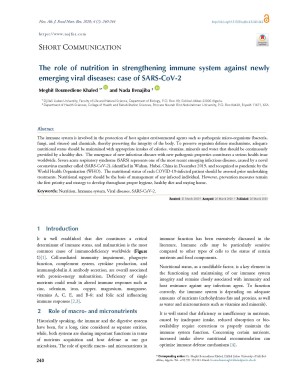
The immune system is involved in the protection of host against environmental agents such as pathogenic micro-organisms (bacteria, fungi, and viruses) and chemicals, thereby preserving the integrity of the body. To preserve organism defense mechanisms, adequate nutritional status should be maintained with appropriate intakes of calories, vitamins, minerals and water that should be continuously provided by a healthy diet. The emergence of new infectious diseases with new pathogenic properties constitutes a serious health issue worldwide. Severe acute respiratory syndrome (SARS) represents one of the most recent emerging infectious diseases, caused by a novel coronavirus member called (SARS-CoV-2), identified in Wuhan, Hubei, China in December 2019, and recognized as pandemic by the World Health Organization (WHO). The nutritional status of each COVID-19-infected patient should be assessed prior undertaking treatments. Nutritional support should be the basis of management of any infected individual. However, prevention measures remain the first priority and strategy to develop throughout proper hygiene, healthy diet and staying home.
Keywords
How to Cite
Similar Articles
- Traditional Tunisian Pasta "Nwasser" Enriched with Wheat Bran: Impact on Physicochemical Quality, Nutritional Profile, and Acute Post-Prandial Glycemic Response in Healthy Individuals
- Physicochemical quality assessment of Brazilian frozen beef imported into Algeria
- Determination of isoflavones from soy-milk, masoor and mung dal soups in Bangladeshi postmenopausal women
- Contents
- Modeling of nitrate leaching kinetics during spinach leaf midribs blanching
- Acid-Induced Gelation of European Eel Protein Isolate Fortified with Fish Oil: Enhancement of Physicochemical, Microstructural and Thermal Properties
- Comparative study of total phenolic content and antioxidant proprieties of Quercus fruit: flour and oil
- Association of socioeconomic status, dietary behavior and obesity among Moroccan adults of the region of Rabat: A case-control study
- Statistical study of the relationship between hyperuricemia, dyslipidemia and type 2 diabetes in rural population of Tizi-Ouzou, Algeria
- Bioenrichment using Satureja montana L. essential oil for the prevention against photooxidation of flavored extra virgin olive oil during light display
You may also start an advanced similarity search for this article.
Most read articles by the same author(s)
- Epidemiology, diagnosis, and assessment of diabetes mellitus in the elderly population: a purposive review
- Predatory journals and publishers at a glance: Take apart or take over?
- Association between breakfast intake and short-term memory, performance and mood among Saudi female adolescents
- Comparison of lifestyle patterns and body weight management practices between normal weight and obese female university students (Riyadh – Saudi Arabia)
- Farm-to-school nutrition programs with special reference to Egypt and Morocco
- Overview on main nutrition-related diseases in three countries from North Africa
- Understanding Bread Consumption and Waste Patterns in Algeria and Tunisia: Insights into Consumer Practices and Challenges
- Physicochemical quality assessment of Brazilian frozen beef imported into Algeria
- Metabolic syndrome and risk of colorectal adenoma and colorectal cancer: A meta-analysis
- New insight on nutrition and COVID-19 pandemic

 NAJFNR is licensed under