The role of nutrition in strengthening immune system against newly emerging viral diseases: case of SARS-CoV-2
Copyright © 2020 Authors

This work is licensed under a Creative Commons Attribution 4.0 International License.
- Attribution — You must give appropriate credit, provide a link to the license, and indicate if changes were made.
- No additional restrictions — You may not apply legal terms or technological measures that legally restrict others from doing anything the license permits.





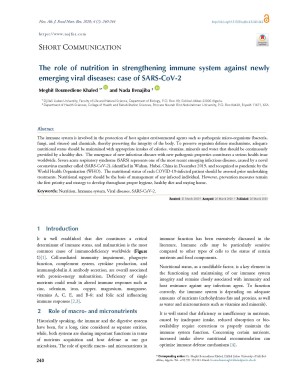
The immune system is involved in the protection of host against environmental agents such as pathogenic micro-organisms (bacteria, fungi, and viruses) and chemicals, thereby preserving the integrity of the body. To preserve organism defense mechanisms, adequate nutritional status should be maintained with appropriate intakes of calories, vitamins, minerals and water that should be continuously provided by a healthy diet. The emergence of new infectious diseases with new pathogenic properties constitutes a serious health issue worldwide. Severe acute respiratory syndrome (SARS) represents one of the most recent emerging infectious diseases, caused by a novel coronavirus member called (SARS-CoV-2), identified in Wuhan, Hubei, China in December 2019, and recognized as pandemic by the World Health Organization (WHO). The nutritional status of each COVID-19-infected patient should be assessed prior undertaking treatments. Nutritional support should be the basis of management of any infected individual. However, prevention measures remain the first priority and strategy to develop throughout proper hygiene, healthy diet and staying home.
Keywords
How to Cite
Similar Articles
- A review of traditional grain-based complementary foods for children aged 6-23 months in selected African countries
- Update of the nutritional situation in Benin Republic
- Nutrient composition of leaves and seeds in selected African Indigenous Vegetables (AIVs): Potential for addressing malnutrition in children under five in Sub-Saharan Africa
- Nutrition in contemporary Zimbabwe: a situational analysis
- Evaluation of Hematopoietic and Immune Toxicity in First-Generation (G1) Rats Following Maternal Thiacloprid Exposure During Gestation and Lactation, and the Protective Potential of Bitter Apricot Kernel Extract
- Use and influence of food and nutrition security vulnerability assessment and analysis reports in Zimbabwe
- Nutrition and food security in Mali from 2010 to 2020
- Predictive equations overestimated the rest energy expenditure by indirect calorimetry in adults with sickle cell disease
- Nutrition Education Intervention on maternal knowledge, and perception toward infant and young child feeding in Abakaliki Metropolis, Nigeria
- Enhancing food and nutritional security through Gender-Disaggregated Analysis: A case study of Lake Victoria Shore, Tanzania
You may also start an advanced similarity search for this article.
Most read articles by the same author(s)
- Epidemiology, diagnosis, and assessment of diabetes mellitus in the elderly population: a purposive review
- Predatory journals and publishers at a glance: Take apart or take over?
- Association between breakfast intake and short-term memory, performance and mood among Saudi female adolescents
- Comparison of lifestyle patterns and body weight management practices between normal weight and obese female university students (Riyadh – Saudi Arabia)
- Farm-to-school nutrition programs with special reference to Egypt and Morocco
- Overview on main nutrition-related diseases in three countries from North Africa
- Understanding Bread Consumption and Waste Patterns in Algeria and Tunisia: Insights into Consumer Practices and Challenges
- Physicochemical quality assessment of Brazilian frozen beef imported into Algeria
- Metabolic syndrome and risk of colorectal adenoma and colorectal cancer: A meta-analysis
- New insight on nutrition and COVID-19 pandemic

 NAJFNR is licensed under