An overview on the nutrition transition and its health implications: Tunisia case
Copyright © 2021 Authors

This work is licensed under a Creative Commons Attribution 4.0 International License.
- Attribution — You must give appropriate credit, provide a link to the license, and indicate if changes were made.
- No additional restrictions — You may not apply legal terms or technological measures that legally restrict others from doing anything the license permits.





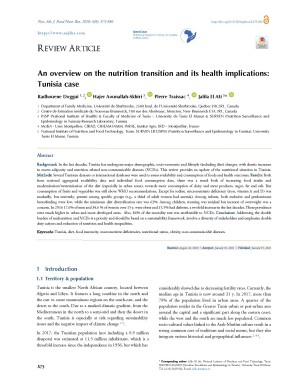
Background: In the last decades, Tunisia has undergone major demographic, socio-economic and lifestyle (including diet) changes, with drastic increases in excess adiposity and nutrition related non-communicable diseases (NCDs). This review provides an update of the nutritional situation in Tunisia. Methods: Several Tunisian datasets or international databases were used to assess availability and consumption of foods and health outcomes. Results: Both from national aggregated availability data and individual food consumption data, there was a trend both of increasing food intake and modernization / westernization of the diet (especially in urban areas), towards more consumption of dairy and meat products, sugar, fat and salt. But consumption of fruits and vegetables was still above WHO recommendations. Except for iodine, micronutrients deficiency (iron, vitamin A and D) was markedly, but unevenly, present among specific groups (e.g., a third of adult women had anaemia). Among infants, both exclusive and predominant breastfeeding were low, while the minimum diet diversification rate was 63%. Among children, stunting was residual but increase of overweight was a concern. In 2016 17.6% of men and 34.6 % of women over 15 y. were obese and 15.5% had diabetes, a twofold increase in the last decades. These prevalences were much higher in urban and more developed areas. Also, 86% of the mortality rate was attributable to NCDs. Conclusion: Addressing the double burden of malnutrition and NCDs is a priority and should be based on a sustainability framework, involve a diversity of stakeholders and emphasize double duty actions and reduction of nutrition and health inequalities.
Keywords
How to Cite
Similar Articles
- Assessment of phthalate knowledge, plastic use practices and cheese handling among adults in Jeddah city (Saudi Arabia)
- Regional and socio-demographic predictors of dietary proficiency of adolescent girls in Nigeria
- Evaluation of Technological Performance of Algerian Soft Wheat Varieties
- Instructions for authors
- Effects of Beetroot and Pomegranate Juice Supplementation on Creatine Kinase and C-Reactive Protein in Amateur Soccer Players
- The Inhibitory Effect of Selenium Supplementation on Tumor Progression in a DMBA-Induced Breast Cancer Model in Wistar Rats
- Relationship between trans fatty acid (TFA) consumption and development of obesity and/or diabetes
- Pre-exposure and Post-exposure new prophylactic treatments against COVID-19 in healthcare workers
- Antioxidant activity and polyphenol composition of Pistacia terebinthus fruit from Tessala (Western Algeria)
- In vitro antifungal activity of aqueous extract and essential oil of African basil (Ocimum gratissimum L.)
You may also start an advanced similarity search for this article.

 NAJFNR is licensed under