Biological and functional properties of vine leaves
Copyright © 2021 Authors

This work is licensed under a Creative Commons Attribution 4.0 International License.
- Attribution — You must give appropriate credit, provide a link to the license, and indicate if changes were made.
- No additional restrictions — You may not apply legal terms or technological measures that legally restrict others from doing anything the license permits.





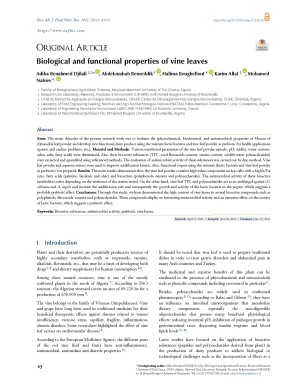
Aims: The main objective of the present research work was to evaluate the (phytochemical, biochemical, and antimicrobial) properties of Muscat of Alexandria leaf powder and develop new functional dairy product using the mixture lactic bacteria and vine leaf powder as prebiotic for health applications (gastric and cardiac problems, etc.). Material and Methods: Various nutritional parameters of the vine leaf powder namely: pH, acidity, water content, ashes, salts, fatty acid) were determined. Also there bioactive substances (TPC, total flavonoids content, tannin content, soluble-water polysaccharides) were extracted and quantified using referenced methods. The evaluation of antimicrobial activity of these substances was carried out by disc method. Vine leaf powder and aqueous extract were used to improve acidification kinetic. Also functional yogurt using the mixture (lactic bacteria and vine leaf powder as prebiotic) was prepared. Results: The main results demonstrate that, the vine leaf powder contains high-value components such as salts with a high k/Na ratio, fatty acids (palmitic, linolenic and oleic) and bioactives (polyphenols, tannins and polysaccharides). The antimicrobial activity of these bioactive metabolites varies depending on the resistance of the strains tested. On the other hand, vine leaf TPC and polysaccharides act as an antifungal against (C. albicans and A. niger) and increase the acidification rate and consequently the growth and activity of the lactic bacteria in the yogurt, which suggests a probable prebiotic effect. Conclusions: Through this study we have demonstrated the high content of vine leaves in several bioactive compounds such as polyphenols, flavonoids, tannins and polysaccharides. These compounds display an interesting antimicrobial activity and an extensive effect on the activity of lactic bacteria, which suggests a prebiotic effect.
Keywords
How to Cite
Similar Articles
- Bioactive compounds and antimicrobial activity of extracts from fermented African locust bean (Parkia biglobosa) against pathogenic microorganisms
- Microwave-assisted extraction optimization and conventional extraction of phenolic compounds from coriander leaves: UHPLC characterization and antioxidant activity
- Assessment of antioxidant and antibacterial activity of Phoenix dactylifera L. seed extracts: Perspective for the development of new foods
- Phytochemical analysis, antioxidant and anti-Candida albicans activities of Annona cherimola Mill. fruit pulp
- Screening of Five Lactobacillus Bacteria with Probiotic Properties from Indigenous Klila Cheese
- Exploring the Antioxidant Potential and HPLC Profile of Fenugreek (Trigonella foenum-graecum L.) Seed Extracts
- Immune-stimulating and antioxidant properties of a traditional Algerian plant combination: Date fruit (Phoenix dactylifera) and Fenugreek seeds (Trigonella foenum-graecum)
- Supplementation species effect on the phenolic content and biological bioactivities of the decocted green tea
- Anti-inflammatory activity of doum palm fruit extract used in the management of benign prostatic hyperplasia
- Antibacterial and antihemolytic assessment of Allium sativum through optimized protein fraction extraction
You may also start an advanced similarity search for this article.

 NAJFNR is licensed under